

A dream garden fairytale is a miniature landscape built to human scale, where a two-inch door wedged into tree roots reads as architecture and a shallow dish of still water becomes a pond.
The trap is scale: a door much larger looks like lost dollhouse junk, and a toadstool cap without the 1.5-to-1 width-to-height ratio stays obvious hardware-store pottery.
Drainage holes drilled through a worn boot sole keep the planting from rotting into smell; without them, the fairy-tale ruin turns sulfurous by July.
[link-whisper-related-posts]1. Tree with a miniature door
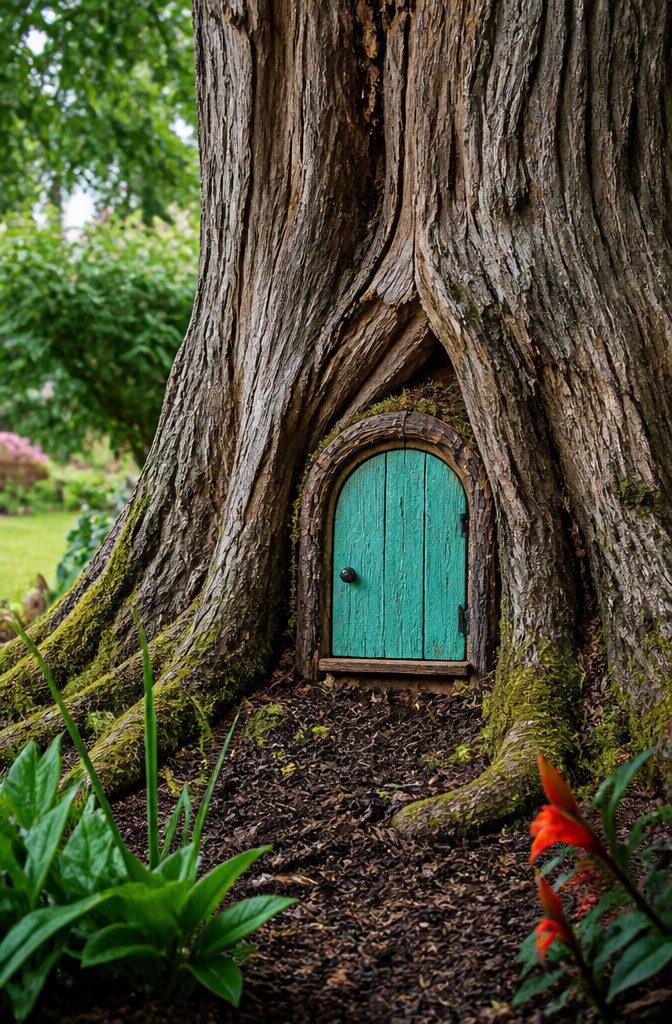
A fairy door wedged into the roots of an established tree is the single most recognizable signal that a garden holds something smaller than ordinary life.
The trunk does the heavy lifting here: its bark provides texture that reads as weathered architecture at one inch high, and any natural gap between two surface roots becomes a threshold without carving.
Scale matters more than detail. A door around two inches tall reads right from a garden path; much larger and it starts to look like a dollhouse prop that lost its house.
The gap you fit it into should sit slightly above soil level, so mulch or moss can bank up to the sill and hide the artificial edge.
An old dolls house door works if the proportions are narrow and tall rather than square. Otherwise, a rectangle of exterior plywood trimmed with coffee stirrers and painted in one color reads better than an overworked miniature.
Wedge it directly into the space rather than framing it out; the job stays an afternoon and you skip hardware that swells or rusts.
For renters or anyone hesitant to modify a tree they do not own, the same door propped against a trunk on a paving stone achieves nearly the same effect and travels with you.
2. Miniature garden in an old container
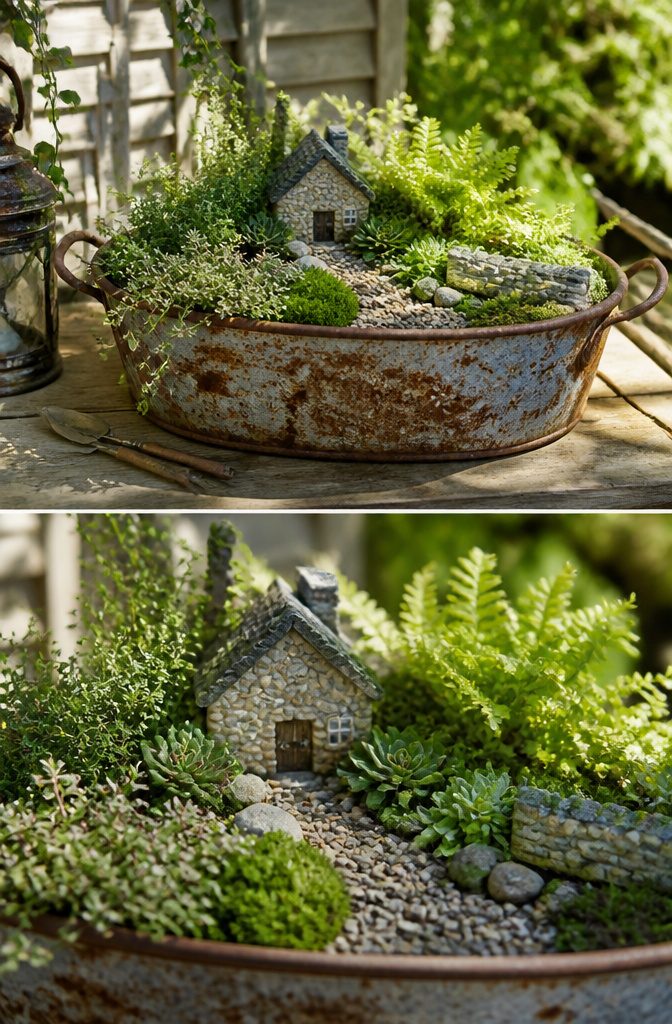
An old wheelbarrow rusting behind the garage, a chipped enamel sink pulled from a bathroom reno, even a galvanized tub that held drinks at last summer’s cookout: these are the bones of a self-contained fairy world that moves with you when the lease ends.
Containers keep the whole scene above ground level, which matters when your outdoor square footage is a balcony rail or a fire-escape landing.
Drainage decides whether the project lasts one season or five. The container needs holes, and if you’re drilling into porcelain or thick metal, a carbide-tipped bit and patience beat force.
Without an exit route, winter rain or overenthusiastic watering rots the roots of the small herbs and succulents that fill these scenes.
Soil depth sets the plant palette. Six to eight inches handles most succulents and creeping thyme; a bathtub’s full depth opens the door to dwarf ferns or a miniature stone house tucked between slightly taller greenery.
Tiny stone houses work whether you buy them online or build from recycled materials, with a path and fence scaled to match.
For renters, the win is reversibility. Landlord sees a garden; you see a removable installation.
Come move-out day, two people can lift a planted wheelbarrow onto a dolly. The fairy garden crosses the threshold intact, ready for the next small space.
3. Mini village with stone houses
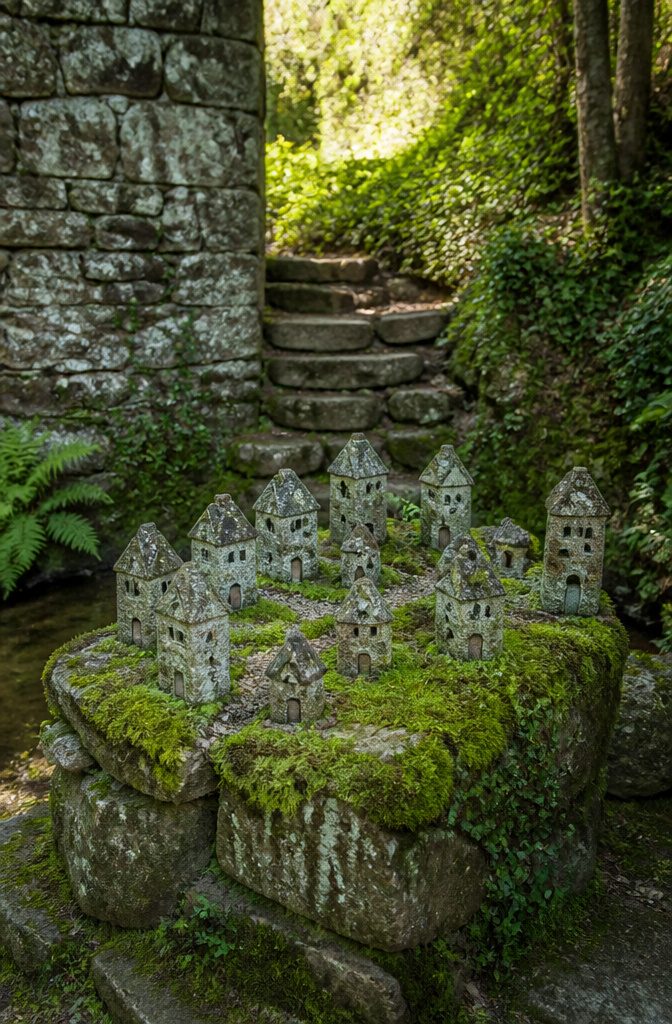
Stone cottages anchor a miniature village in a way resin never quite manages.
Real stone weathers, collects lichen, and settles into the garden as though it has always been there; resin cracks in UV light and starts looking like a toy by year three.
I would start with three houses at minimum, since fewer reads as scattered objects rather than a settlement.
The scale that keeps them legible as a village, not clutter, sits around 1:12 to 1:24, roughly dollhouse-to-half-dollhouse size. Any smaller and the eye loses the architecture; larger and the houses start competing with the actual plants.
Cluster them with winding paths between, each house set slightly at a different angle so the grouping feels accidental rather than lined up like a parking lot.
A shaded corner or the dappled light beneath a shrub works better than full sun, both for the moss that eventually creeps onto real stone and for the illusion that these are dwellings someone might actually inhabit.
You can give each its own tiny garden patch and a gravel path, or park a toy car outside one door to suggest a resident just stepped away.
4. Water feature with fairy models
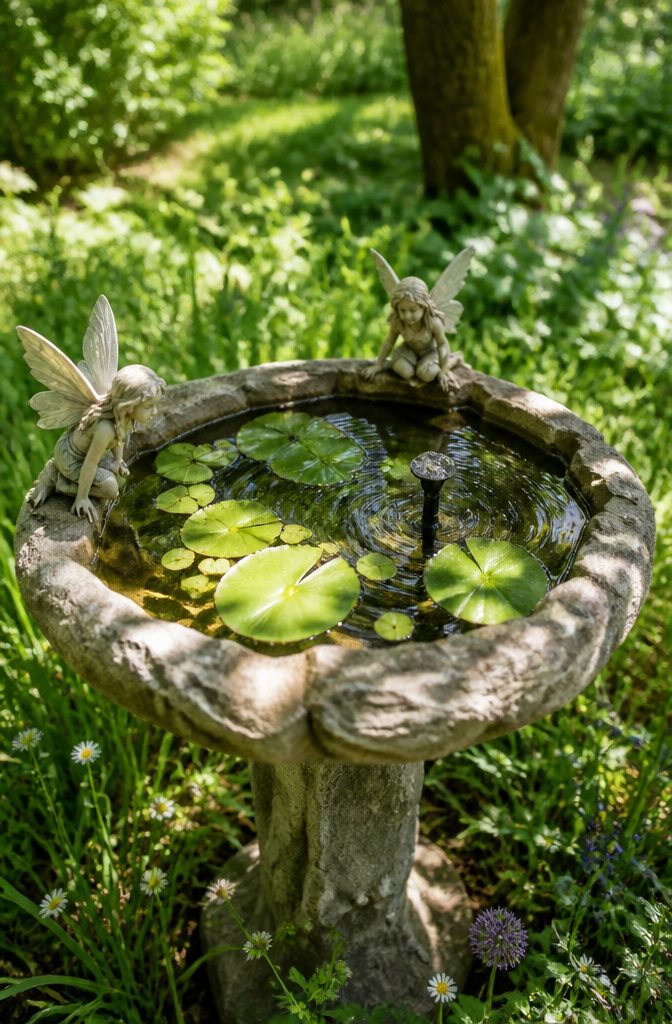
A small recirculating pump turns almost any shallow bowl or buried dish into a water feature that reads as a pond in miniature scale.
Birdbaths work especially well: their existing pedestal lifts the water to eye level, and the basin already holds water without leaking.
I prefer solar-powered pumps for containers under 20 gallons, since the 1.5 to 2.5 watt range moves enough water for a soft trickle without splashing out the sides.
A pump rated closer to 5 gallons per hour suits a buried saucer; anything stronger overwhelms the edge.
Fairy figurines placed at the rim do the narrative work.
One figure crouched to peer at the surface suggests a different story than two seated on a tiny stick bench with a scrap of cloth dropped beside them as a towel.
The water line matters: keep it half an inch below the rim so the figures stand on visible ground, not half-submerged.
Lilies or small floating plants break up the surface and give the fairies something to look at, though in a container this small you will be trimming roots monthly to keep the pump clear.
5. Toadstool garden with painted pots
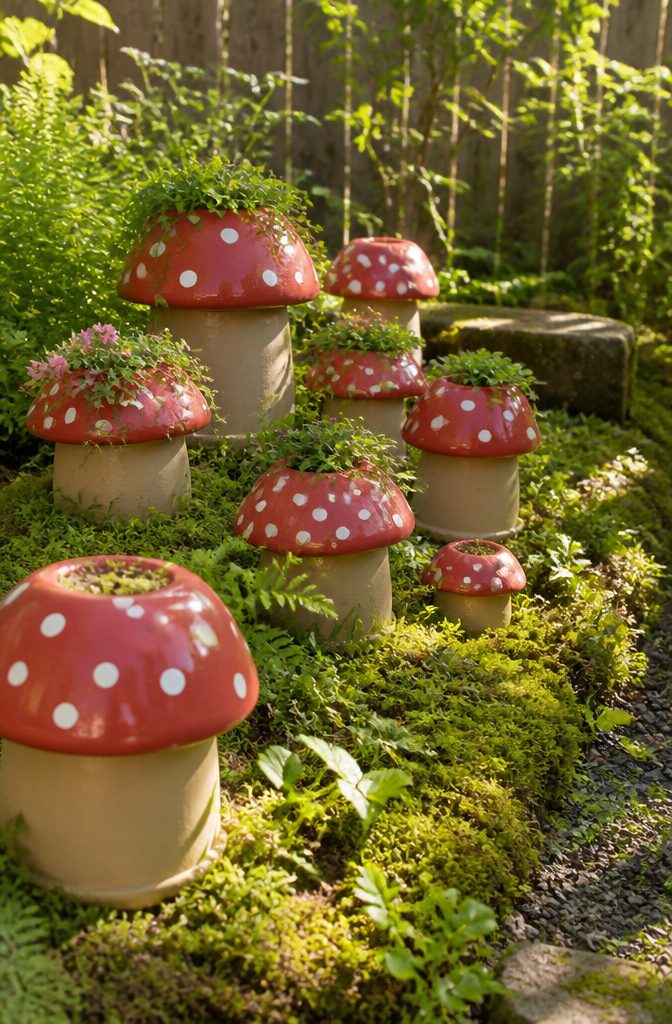
The terracotta pot inversion technique turns two cheap nursery pots into a mushroom silhouette with almost no cutting.
One pot becomes the domed cap, flipped upside down; a second stays right-side up for the stem. Clay flares at the rim differently than plastic, so the joint reads as a natural overhang rather than a stacked cylinder.
Exterior paint on raw terracotta needs a bonding primer first, or it will chalk off by fall.
I would skip acrylic craft paint entirely and go straight to exterior latex rated for masonry; the extra cost per pot is maybe two dollars, and the finish survives three seasons instead of one.
For color, the classic scheme is a cream-spotted red cap with an off-white stem, but a muted sage with oatmeal spots reads more weathered against real garden greens.
Scale is where most of these fail. A cap diameter roughly 1.5 times the stem height triggers the toadstool recognition in your eye; anything closer to 1:1 looks like what it actually is, hardware store pottery stacked wrong.
Cluster three at staggered heights rather than lining them up, and the grouping starts to read as something that grew there.
6. Mysterious footsteps to a tiny door
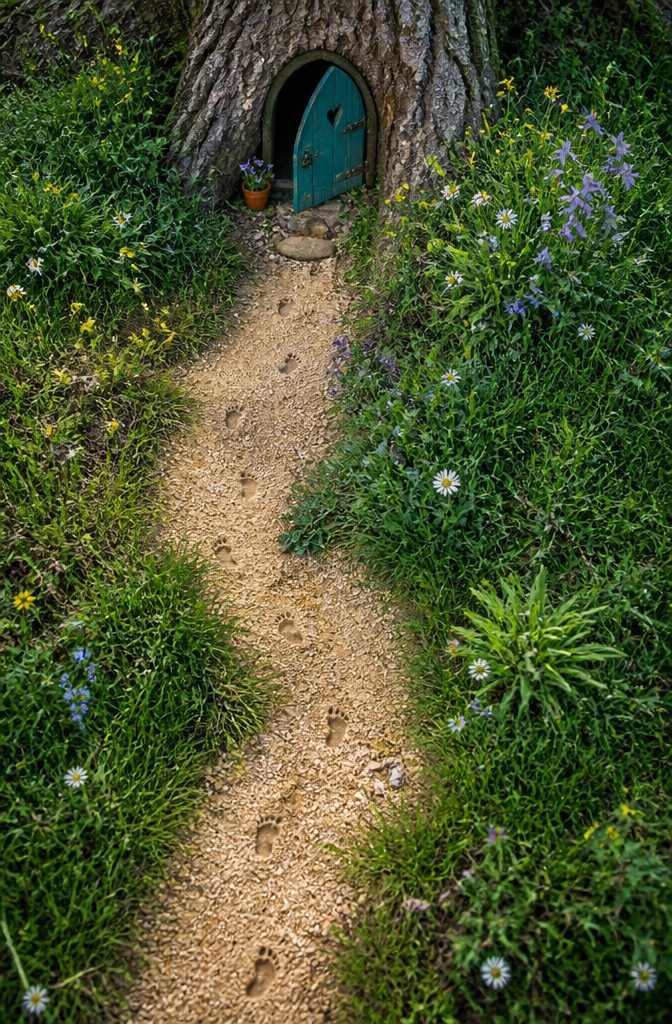
A path only works if it looks traveled, and the stride gives it away. Space footprints four to six inches apart, heel to toe, which reads as a small creature in a hurry rather than a child tiptoeing.
Pressed gravel holds the shape longer than bare soil, and a quick mist of water before you stamp firms the surface without turning it to mud.
Painted stones run the same risk: too large and the spell breaks.
A chunky highlighter cap pressed into concrete or air-dry clay makes the main pad, and a standard pen cap finishes the heel. Let them cure, then nestle each stone flush with the ground so grass can creep at the edges.
The trail needs a door worth reaching.
A corner of fence or the base of a tree trunk does the job; the origin point can be vague, a single pair of prints fading from view, but the destination must resolve the mystery.
A tiny painted door, even a flat one screwed flush to bark, rewards the eye that follows the path. Without that finish, the footprints read as litter.
7. Miniature window box from a bird box
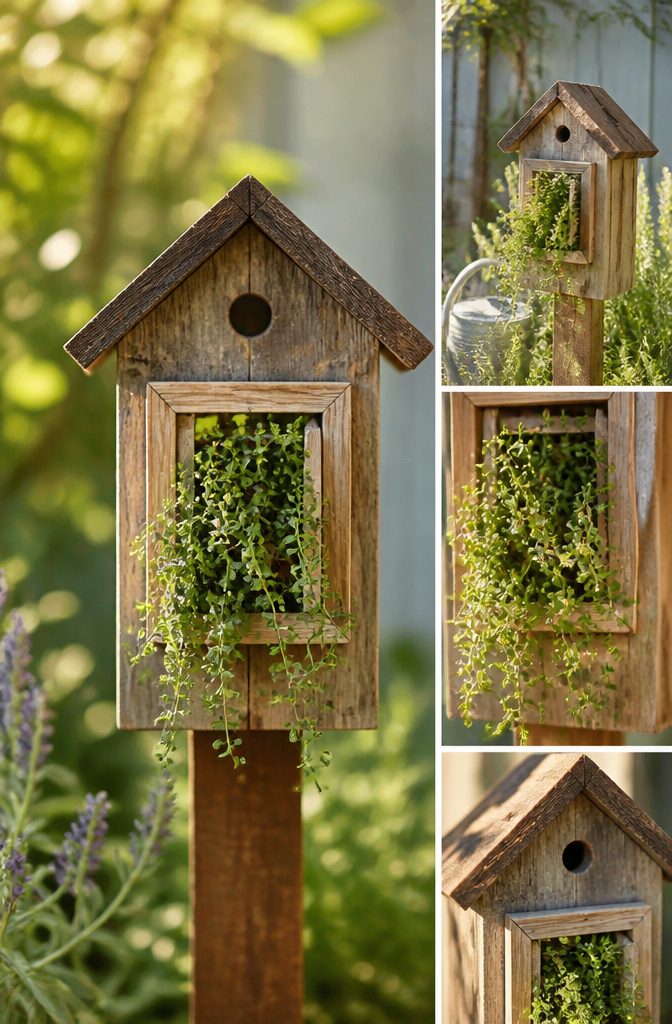
A wooden birdhouse with a single entrance hole is already half a fairy window box; the work is in turning that hole into a believable opening and giving the plants somewhere to sit.
I cut the hole into a rough rectangle with a fine blade, then tack in a scrap of balsa for a sill, thin enough not to read as heavy carpentry at this scale.
The roof stays pitched, the paint stays weathered, and that mismatch between rustic shell and delicate planting is what sells the illusion.
For filling, creeping thyme handles the dry soil and tight root space better than most ground covers, though baby tears give a lusher curtain if you are willing to water more often.
Either one spills over the sill in a week or two once established.
Mount the box at eye level or just below, not looking down onto it from above; the forced perspective only works when the viewer meets the window straight on.
8. Fairy worlds with dolls house furniture
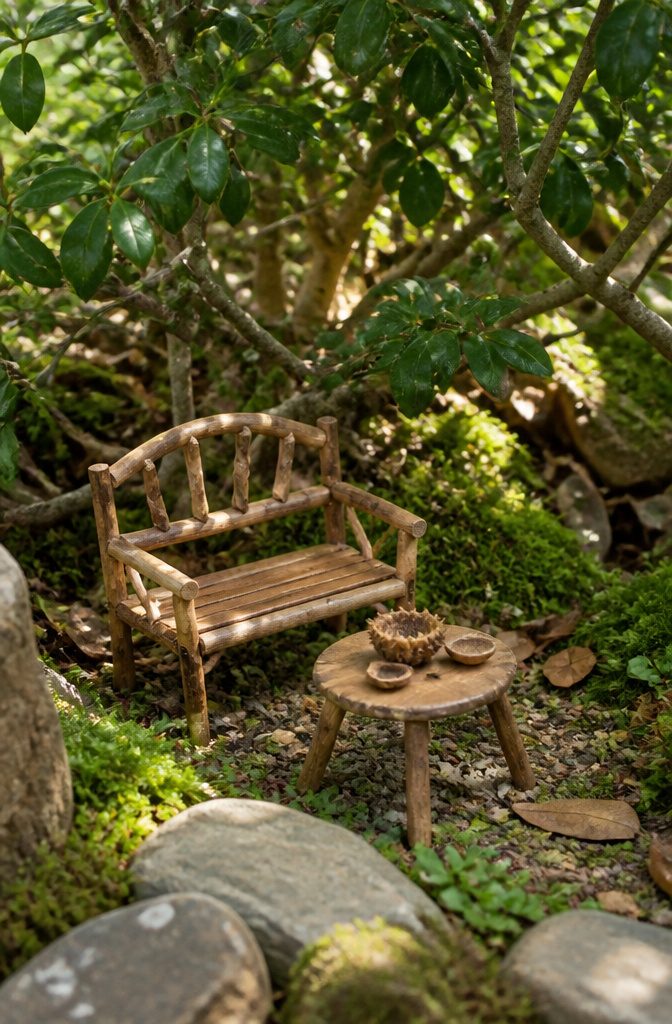
The 1:12 scale of standard dolls house furniture sits right at the edge of what reads as fairy-proportioned in an outdoor bed. Too large and the piece looks parked, not lived-in; too small and it disappears against soil and leaf litter.
I look for benches with slatted backs and tables with visible legs, because solid blocks of wood weather badly and read as toys rather than borrowed furnishings.
Raw wood softens and warps through a single wet season unless it is sealed.
Spar urethane holds up in sun and rain, though it yellows pale paint over two or three years. A bench tucked under a low shrub gains believability from the shadow line, as though something stepped out of it moments ago.
A table set with seed-pod dishes, a thimble for a pot, completes the suggestion of use without crowding the scene.
One piece of furniture and one prop do more than a full dining set, which starts to look like a catalog arrangement the moment rain spatters it.
Placement matters more than variety. A single chair angled toward a moss patch implies a watcher; two facing each other need a path between them or the story collapses into display.
9. Miniature water feature in a dish
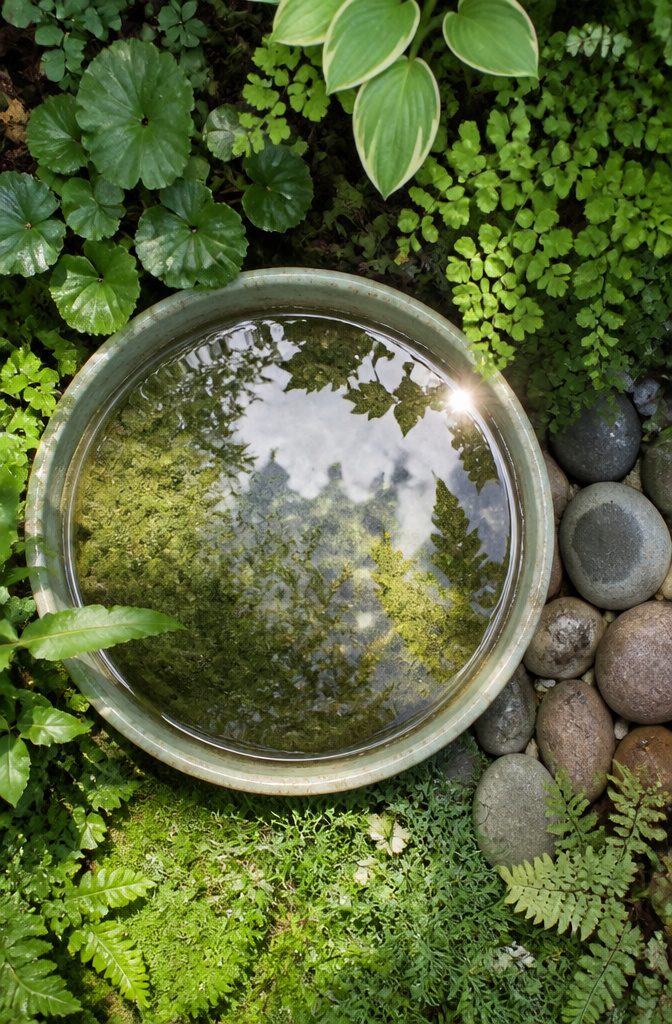
A shallow ceramic dish with two inches of still water is the quickest way to bring a reflective surface into a miniature garden.
The standing water catches sky and surrounding foliage, doubling the visual depth of a small space without any plumbing or pump noise. I consider this the lowest-commitment water option because moving parts fail, and here there are none.
The trade-off is mosquitoes. A single mosquito dunk tablet, broken to quarter size, lasts a month in dish-scale water and targets larvae without touching plants or visiting insects.
For surface texture, aquatic moss such as java or christmas varieties spreads across the bottom in low light and reads as a forest floor viewed through perfect glass.
Without moss, the mirror effect is cleaner but the scene turns sterile fast; I would rather have the green fuzz breaking the reflection slightly than a swimming pool in a fairy garden.
Evaporation runs higher than expected on warm weekends, so the dish needs topping off every few days.
Skip the fountain kits for this scale. The stillness is the point, and the upkeep is a glance and a pour.
10. Fairy tea party scene

A miniature tea party draws the eye faster than any other detail because it reads as an invitation.
Children see a place they could join; adults see a story already in progress. I set mine on a flat stone the size of a dinner plate, low enough that the cups sit below the surrounding foliage.
The cups are acorn caps, split for stability so they don’t tip. Leaf plates work best from something broad and slightly stiff: nasturtium, hosta, or lemon balm, which holds a crease without tearing.
Petal napkins are thin-petaled blooms, pressed flat under a book for an hour so they dry into cloth-like folds rather than curling.
The scale matters more than the craftsmanship. Cups under an inch wide keep the scene believable; anything larger looks like doll furniture dropped in a garden.
I arrange three place settings, never four. An empty chair implies a guest who just left or one expected soon, and that slight incompleteness keeps people looking.
The whole setup costs nothing if you have acorns and leaves in the yard, and it takes twenty minutes to assemble.
Rain will ruin it in a day or two, which is why I keep a spare set pressed between paper towels in a kitchen drawer.
11. Bonsai trees as miniature worlds

A mature bonsai already carries the architecture of an enchanted forest.
The trunk has weathered decades into gnarled bark, the canopy spreads at a scale that reads as full-sized when you kneel beside it, and the negative space between branches suggests depth no miniature garden achieves with ground-cover plants alone.
The tree does the work of atmosphere before you add a single figure.
The root systems demand care. Most bonsai roots spread shallow and wide, and fairy-garden figurines driven into the soil can sever the fine feeder roots that sustain the tree.
I set figures on flat stones or weathered wood slabs laid on the surface, or wedge them into the crevices of the trunk itself.
A ceramic toadstool perched on a rock beside the pot reads as belonging to the same world without risking the living structure beneath.
For outdoor survival across the broad middle of the country, juniper and Japanese maple handle zones 5–9 with established winter protection at the colder end.
Chinese elm tolerates the swing better than most, dropping leaves in fall but recovering reliably in spring.
Skip the tropical species sold as indoor bonsai: ficus and serissa die fast in a zone 7 frost, and replacing a mature specimen costs more than the rest of the garden combined.
The right species in a weathered pot, with one or two figures placed on stone, gives you a forest that feels ancient and untouched.
12. Goldfish bowl garden
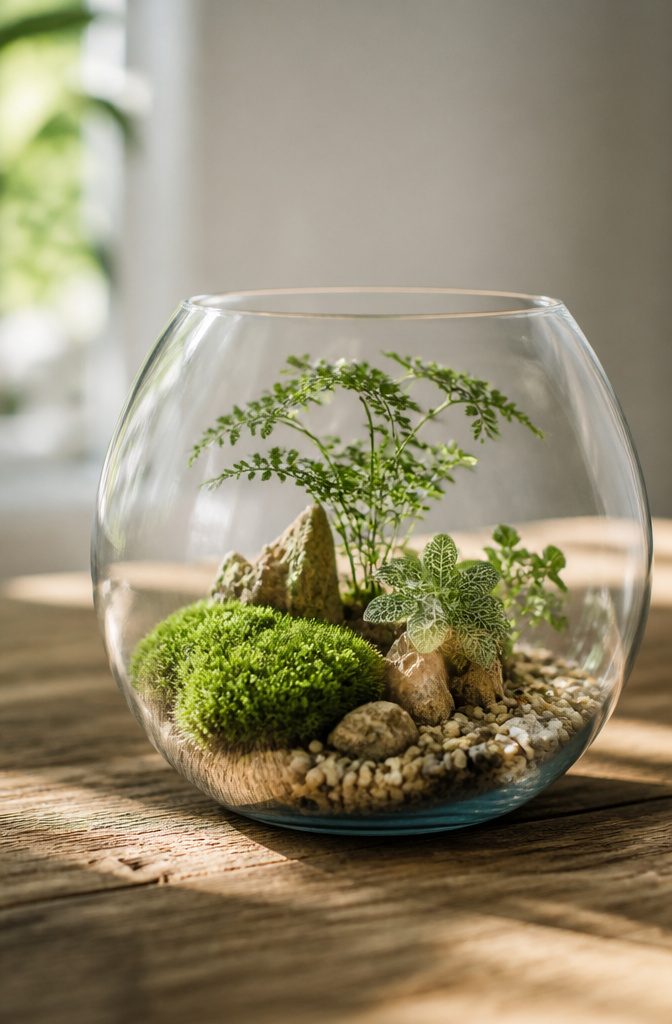
A goldfish bowl garden gets its name from the shape, not the residents. Live fish are not involved.
What you are building is a closed terrarium or an open bowl planting scaled to a tabletop, which makes it one of the few dream garden fairytale options that works in an apartment with no outdoor space at all.
The curved glass matters more than it looks. It magnifies what is inside, so a single tiny stone house or a sprig of moss reads as a landscape rather than a knickknack.
For a closed bowl, a drainage layer of small stones at the bottom keeps roots from rotting; an open bowl dries faster and needs less engineering but more frequent watering.
Both setups use only a small amount of compost and one or two small plants, with moss for grass and sticks for structure.
I would skip the fairy dolls unless you already own one.
The bowl itself does the enchantment. A plain glass sphere with one creeping fig and a few pebbles looks more like a world than a craft project crammed with figurines.
13. Old shoe as a garden feature

A worn leather boot with its laces still threaded makes a more convincing fairy-tale ruin than a pristine garden store planter ever could.
You need to drill three or four half-inch holes through the sole before you add soil; without drainage, you will have standing water and a smell that belongs nowhere near a garden.
I have found that leather and canvas rot down gracefully, softening at the edges and growing a pale green bloom of moss that reads as intentional age.
Rubber soles, on the other hand, hold their shape but trap anaerobic pockets underneath.
The result is a sulfurous stench that rises on warm days and lingers. If the boot has a synthetic wedge or heavy tread, I would skip it.
Fill to the ankle with potting mix, then tuck in trailing sedum or nasturtium.
Sedum spreads flat and threads over the eyelets like it has always lived there. Nasturtium cascades faster and gives you edible flowers from June through frost.
Both tolerate the shallow soil and the heat that builds against dark leather. Position the boot on its side, heel slightly raised on a flat stone so water runs out, and let the plant do the storytelling.
14. Little Miss Muffet scene
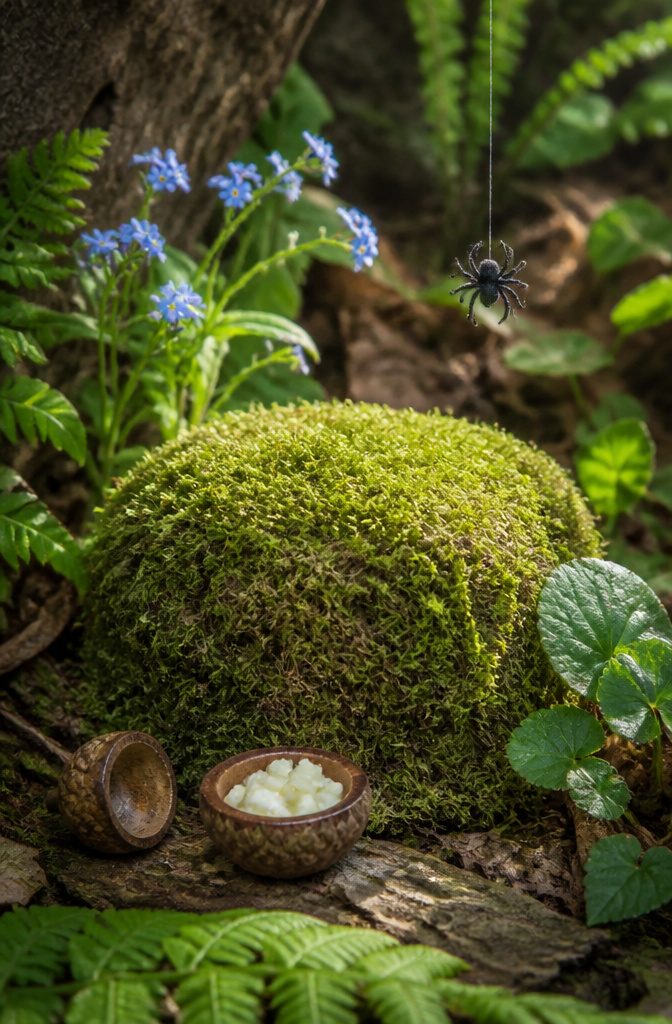
A nursery rhyme tableau gives a miniature garden its story in one glance, and the tuffet is what makes Miss Muffet unmistakable.
The word itself names a low seat or mound, so any raised spot qualifies: a domed clump of moss, a small flat stone, or a tiny toadstool stool painted in red and white spots.
Place a miniature bowl beside it for the curds and whey, and the scene reads instantly even to a child who barely knows the rhyme.
The spider finishes the joke. A toy spider perched on the tuffet’s edge or dangling from a thread of fishing line turns the setup into a moment of action.
Leave an empty basket behind, the dropped snack that proves she ran. That detail matters more than elaborate construction; one forgotten prop does more for the fairy tale quality than a dozen perfect flowers.
Scale is the usual pitfall. A spider half the size of the figure looks comic rather than menacing, and a tuffet taller than the figure turns the rhyme into something else entirely.
Keep the spider small, the seat low, and the bowl no larger than a thimble.
15. Hanging fairy garden in a basket
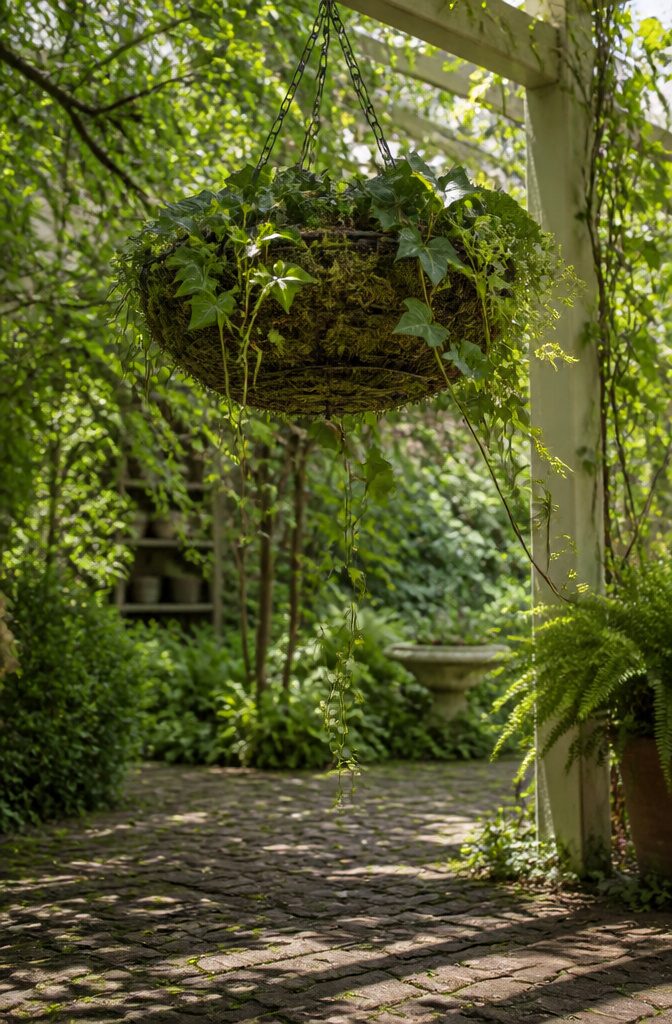
A moss-lined wire basket hung at eye level or higher turns the whole idea of a container garden inside out.
You plant through the sides and bottom so the growth spills downward, and from a few steps back the whole thing reads as a floating island of green with no visible support.
I like wire baskets with a loose weave and a coconut or sphagnum liner that stays damp without turning to sludge; the moss gives you something to root into, and it weathers to a soft silver-green that already looks like it belongs in a storybook.
Trailing plants do the actual magic. Creeping Jenny, small ivy, and baby tears all have the scale and the habit to read as meadow spilling off a cliff edge.
Plant densely, because from below you are looking straight up at soil and liner wherever foliage gaps. Watering means soaking the whole mass until it drips; the weight adds up fast when saturated.
Standard ceiling hooks rated for 15 pounds are not enough once the basket is wet and established. I would not hang one on anything less than a 50-pound anchor into solid structure, and I check the hardware each spring.
The basket wins because it asks almost no floor space, but the limit is real: too heavy, too high, and a failed hook means a shattered pot and a hole in the story.
16. Animal kingdom with Sylvanian families
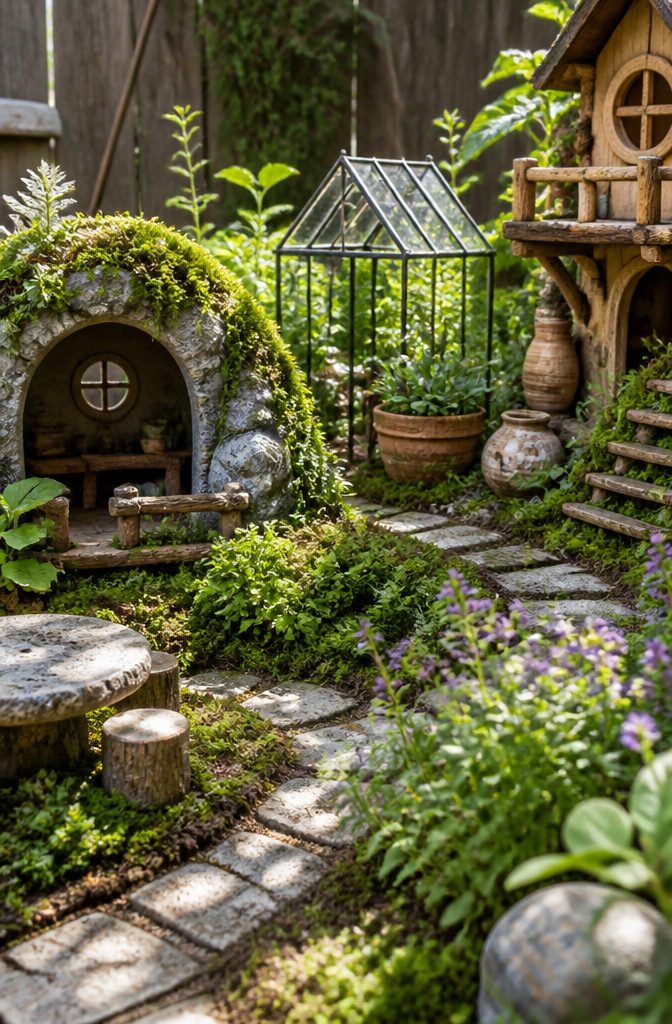
Small animal figurines read differently in a miniature garden than winged fairies perched on toadstools.
Where fairy scenes invite a single magical narrative, animal families turn the bed into a village with its own daily routines, and that shift matters when you are deciding what story your garden tells.
Calico Critters, sold as Sylvanian Families outside North America, scale cleanly to miniature garden use. The figures stand roughly two inches tall, which pairs well with tiny houses built from recycled bird boxes or small prefab structures.
The proportions feel lived-in rather than staged: a rabbit mother pushing a pram past a moss-lined path reads as ordinary life made small, not a spectacle.
The practical note is worth keeping in mind. These figures are not weatherproof resin; the painted details and flocking on a Sylvanian hedgehog or bear will not survive a rainstorm.
Bring them in when the forecast turns, or treat them as seasonal visitors you set out for a weekend and pack away after.
Animal narratives also give the garden a different emotional temperature.
A fairy scene asks the viewer to believe in magic. A family of miniature beavers repairing a twig dam asks the viewer to recognize care and habit.
For renters or first-home owners building a garden in a container they will move season to season, that recognizability is an advantage: guests lean in to see which animal is which, not to decode a fantasy.
17. Garden gnomes as decorative elements
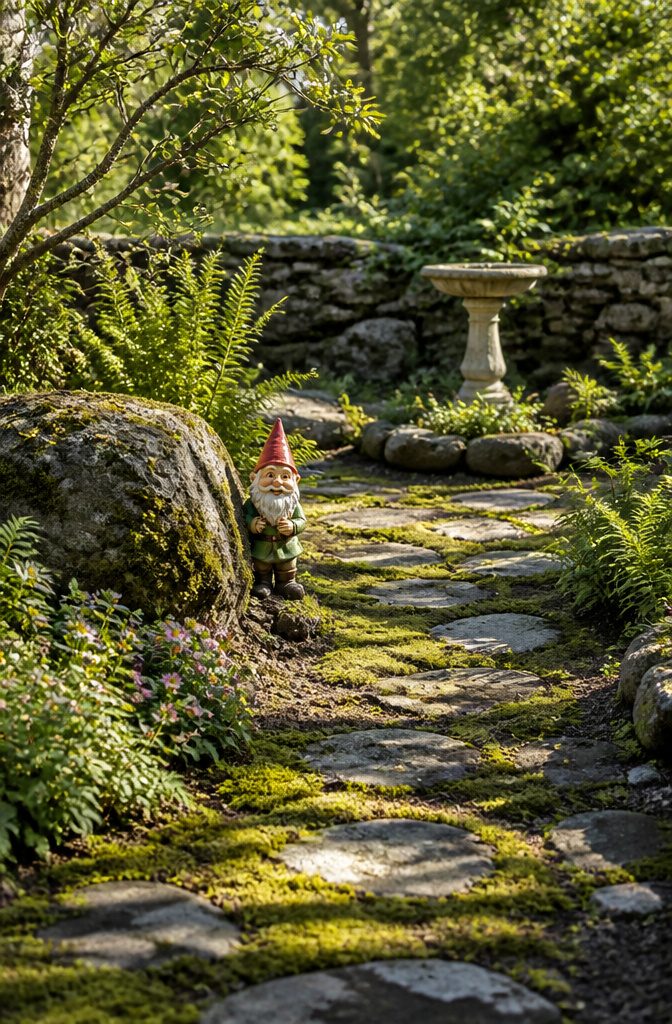
Traditional gnome placement puts a single figure at the edge of a flower bed, staring toward the house like a lawn ornament.
Fairy garden integration works differently: the gnome becomes a character inside the scene, scaled to read as part of the miniature world rather than a giant who wandered in.
Standard 8-inch gnomes tower over 3-inch fairy doors and teacup furniture. That scale mismatch breaks the spell instantly, turning a whimsical vignette into a toy store explosion.
I keep the big ones for container edges or the base of a tree, where they function as a viewer entry point, a full-size human peering into the tiny world.
Where gnomes still belong: tucked behind a moss-covered rock so only the hat shows, or seated on a real stone that reads as a boulder in the scene.
Where they fail: standing in the middle of a miniature path, dominating the tea party you spent an hour arranging.
The smaller resin gnomes, the ones under 4 inches, integrate cleaner. They sit at the same scale as fairy figures and do not fight the furniture for attention.
My preference runs to using one gnome as a gatekeeper, placed where the real garden meets the miniature one.
Inside the scene itself, I skip them entirely. The fairies own that space.
18. Mini world on a budget using recycled materials
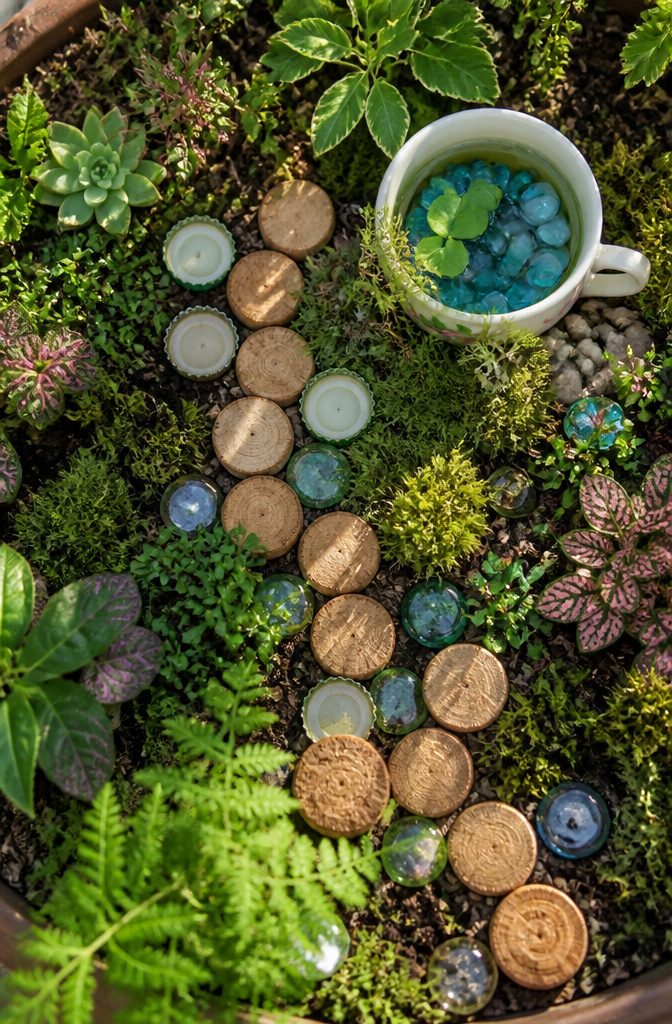
Corks make the best stepping stones in a miniature garden because they already look like tree rings and they float, so a rainstorm won’t scatter the path.
Wine corks work, but champagne corks give you a wider surface, and the foil cap can stay on for a metallic hint or peel off for raw bark texture.
Bottle caps flip upside down to become shallow planters or wading pools; the painted ones read as ceramic glaze, and the plain aluminum ones take acrylic paint if you want them to match a color story.
Popsicle sticks build fences, benches, and ladder-back trellises, though they will soften and warp over a season unless you seal them with the same exterior glue that holds everything together.
That glue is the one purchase worth making even here.
Standard white craft glue turns to jelly in humidity, and hot glue releases the moment the sun hits it. A 4-ounce bottle of exterior-grade wood glue costs about six dollars and will outlast several rounds of materials.
Broken crockery fills the rest: a teacup handle becomes a garden arch, a saucer edge turns into a painted pond rim, and the crazed glaze on old plates looks exactly like witchy cottage stonework.
Keep the total under $30 by sourcing corks and caps from your own recycling bin first, then asking at a local restaurant or pottery studio for the crockery they would otherwise trash.
The only real limit is scale; these materials suit a garden built inside something the size of a boot tray or a wide planter saucer, not a full raised bed, because a single popsicle-stick fence at twelve inches tall would need hundreds of sticks to enclose it.
Work small, glue aggressively, and the thrifted look becomes the charm rather than the compromise.
Design principles for fairy tale atmosphere
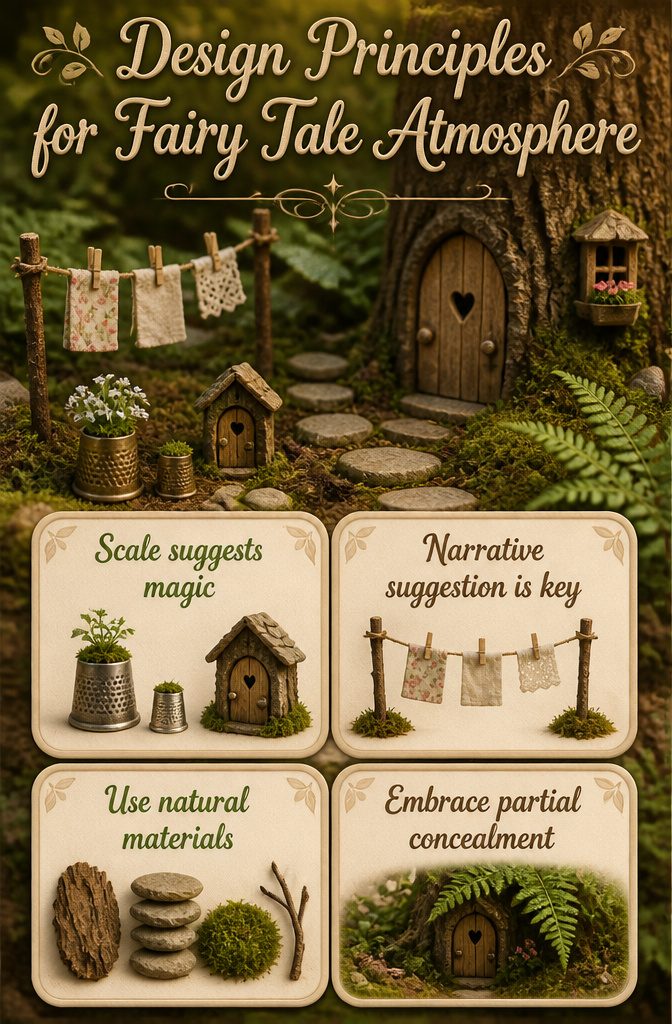
The logic running through all eighteen ideas is the same one that makes a half-hidden path more tempting than a fully lit walkway.
Scale comes first: every object needs to read as borrowed from something larger, whether that is a thimble repurposed as a planter or a biscuit tin cut down to house size.
The eye recognizes the form but not the size, and that small wrongness is what signals magic rather than model railroad.
Narrative suggestion matters more than completion.
A string washing line hung between two twigs only works because the viewer supplies the rest: the fairy who hung the damp cloth, the house out of frame. The designs that hold up best stop at the gesture.
A door set into a tree trunk or a window box built from a bird box gives you an entrance, not a full scene, and partial concealment is what keeps the imagination active.
If the whole village is visible from one angle, it becomes a display. Tuck some of it behind a fern or place the stone houses so one hides another, and the garden starts to feel inhabited rather than arranged.
Natural materials carry this better than manufactured ones.
Weathered wood, flat stones, moss, and bark all age into the setting instead of aging out of it. The aged cubby house built decades earlier and restored in place worked precisely because it had already settled into its site.
New construction would have read as set dressing. I would rather build a door from found twigs that warp slightly by fall than install a clean-cut miniature that stays perfect and therefore stays false.
The cost is durability: bark peels, string frays, and a thimble left outdoors will rust. That decay is part of the story, but it means these gardens need rebuilding, not just maintaining.
Plants that read as enchanted
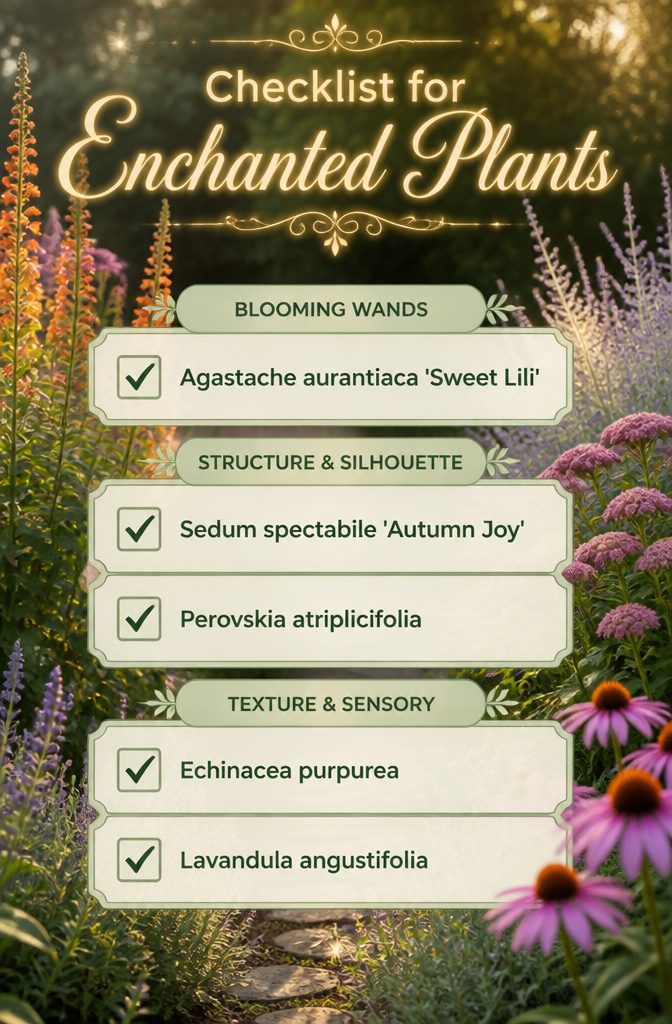
Agastache aurantiaca ‘Sweet Lili’ carries a honeyed scent that rises in late afternoon heat, the kind of fragrance that makes a garden feel watched over rather than merely planted.
I put it at the back of a border, where its 18-inch wands catch light behind lower companions.
Height and texture do the enchantment work that color alone cannot. Sedum spectabile ‘Autumn Joy’ builds a dome of blue-green flesh through summer, then rusts to copper-pink heads that hold into frost; the silhouette shifts, keeps the eye moving.
Perovskia atriplicifolia adds silver stems that read as mist from a few feet back, and the gray of its cut-leaf foliage cools down hotter blooms without needing to compete.
Echinacea purpurea gives you a brown cone that finches work over in autumn, coarse against the finer stuff, and Lavandula angustifolia tucks in at knee height with gray blades and that particular resinous clean smell that reads as old-world whether you planned it or not.
I arrange these so something is always going to seed while something else is tight in bud: the garden moves through stages instead of hitting one color note and fading.
The thread that holds it is scent and touchable surface, not a palette chosen from a wheel.
Frequently Asked Questions
What are some ideas for a fairy tale garden?
A dream garden fairytale can include a miniature door wedged into tree roots, a self-contained fairy world in an old wheelbarrow or sink, a village of real stone cottages, a recirculating water feature with fairy figurines, painted toadstools made from inverted terracotta pots, mysterious footsteps leading to a tiny door, a window box built from a birdhouse, bonsai trees as ancient forests, or a hanging moss-lined basket that spills plants like a floating island.
Each idea scales down a familiar garden element so it reads as a world in itself.
How can I create a magical garden for children?
Build scenes that invite them to lean in and believe. A miniature tea party with acorn-cap cups and leaf plates set on a flat stone reads as an interrupted picnic they might join.
A Little Miss Muffet scene with a tiny tuffet, thimble-sized bowl, and a toy spider dangling from fishing line tells a story they already know.
Animal figurines like Calico Critters arranged in daily routines turn the bed into a village with its own life.
What are the rules for a fairy garden?
Scale is the governing rule. A fairy door around 2 inches tall reads right from a path; much larger and it becomes dollhouse debris.
Stone houses work best at 1:12 to 1:24 scale. Footprints spaced 4–6 inches apart heel-to-toe suggest a small creature, not a child.
One piece of furniture and one prop do more than a full dining set. The finish must resolve the mystery: a trail needs a destination door, or it reads as litter.
What is the story behind fairy gardens?
The tradition draws on the same impulse as dollhouses and model villages: the pleasure of a world scaled to the hand and eye. A fairy garden differs in its intentional incompleteness.
An empty chair, a dropped basket, a single pair of footprints fading from view all invite the viewer to finish the narrative. The garden is not a display but a scene interrupted, and that gap is where the imagination lives.
What does it mean to dream of a beautiful garden?
It treats dream garden fairytale as a waking project: the construction of small enchanted spaces in containers, tree roots, and corner beds.





