
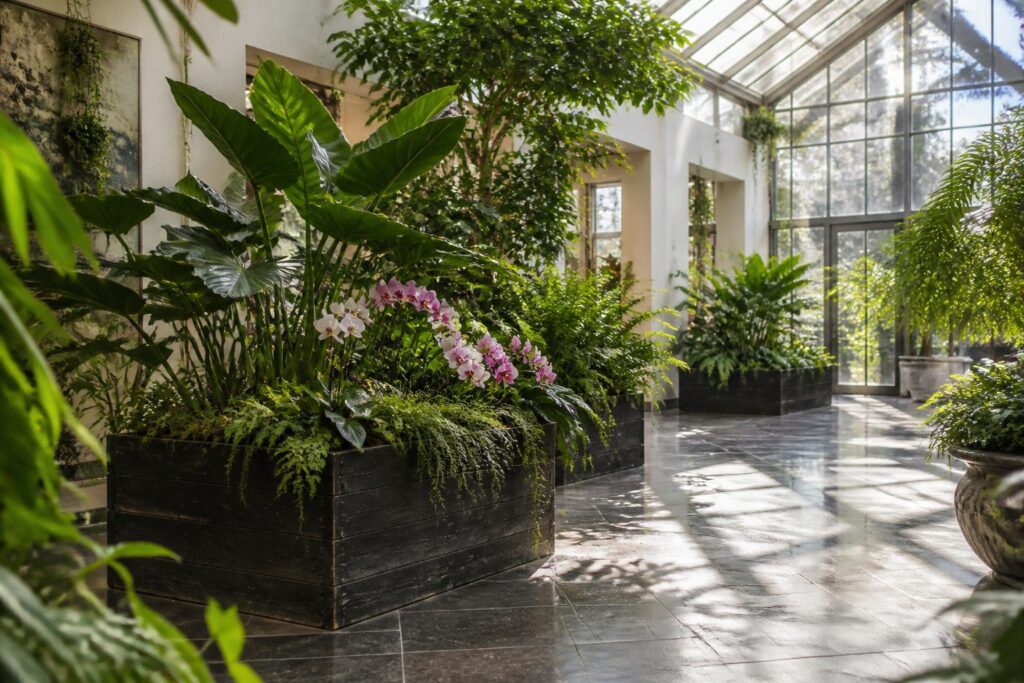
A botanical garden inside is a climate-controlled glass building or conservatory that keeps tropical and subtropical plants alive through winter in places like New England or the upper Midwest.
The problem is that these spaces vary wildly in engineering age and operating logic, so the experience changes depending on whether you walk into a Victorian iron dome or a 2019 biome built to separate humid and dry zones by function rather than geography.
Wellesley College’s 2019 Global Flora Conservatory, for example, groups its collection by climate function across three distinct biomes rather than by geography or taxonomy, a deliberate break from the Victorian tradition that shapes most older American glasshouses.
[link-whisper-related-posts]Global Flora Conservatory
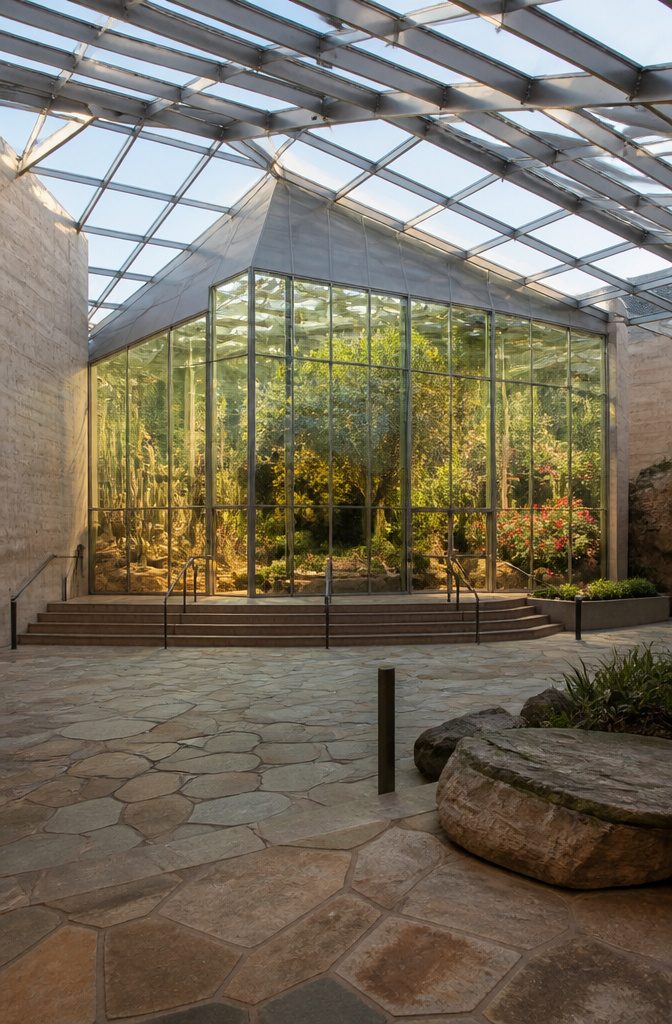
Wellesley College’s Global Flora Conservatory opened in 2019 with a deliberate break from the Victorian glasshouse tradition.
Where older conservatories often arrange plants by geography or taxonomy, this indoor botanical garden groups three biomes by climate function: the Camellia Pavilion, the Dry Biome for desert-adapted species, and the Wet Biome for subtropical humidity.
The collection draws from every continent except Antarctica, so a single afternoon moves you from camelias to cacti to cloud-forest understory.
I like that the design trusts visitors to read ecosystems rather than labels. The Dry Biome alone holds plants from deserts worldwide, which means you are comparing convergent adaptations, not checking off countries.
For someone planning a weekend conservatory trip from Pinterest research, that coherence matters. You leave with a sense of how plants solve similar problems in different places, not just a list of pretty rooms to photograph.
The 2019 build also means the envelope performs better than century-old glass.
I would bet the heating bill here runs lower per square foot than at the older New England conservatories on this list, though that savings went into the biome engineering instead of ornament.
Roger Williams Park Botanical Center
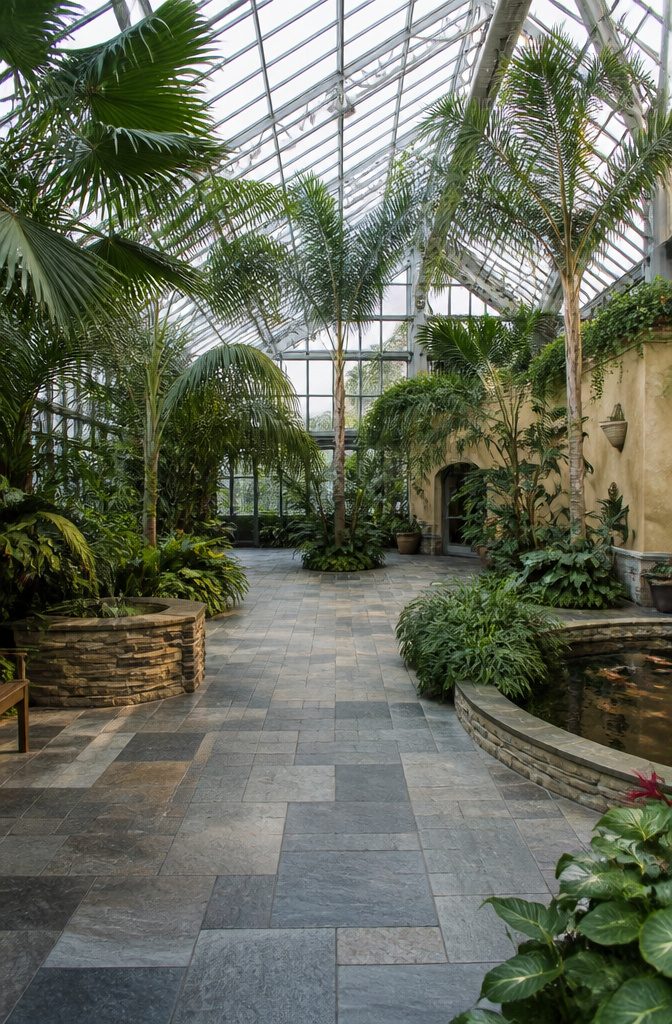
The Roger Williams Park Botanical Center opened in 2007 with 12,000 square feet of indoor garden, making it the largest public indoor display garden in New England.
That scale matters on a February afternoon when Providence is gray and the nearest green feels counties away. Two connected greenhouses fill the space: the Conservatory and the Mediterranean Room.
The Conservatory reads as a tall courtyard. Palms rise overhead, a fountain runs somewhere out of sight, and birds of paradise sit back among the fronds where you have to look for them.
The Mediterranean Room centers on a planted pond with koi, backed by a long stucco wall and a circular gate. Water falls twice, from a small waterfall and a separate fountain, so the sound carries.
Between both rooms, the collection holds over 150 species and cultivars, including 17 types of palms. For a renter or weekend visitor, the square footage translates to actual walking room.
You are not threading a narrow path between ropes; you can stand still, look up, and let the humidity register. The center runs on public-park hours, not event-ticket pricing, which keeps it practical for a quick reset between projects.
Lyman Conservatory at Smith College
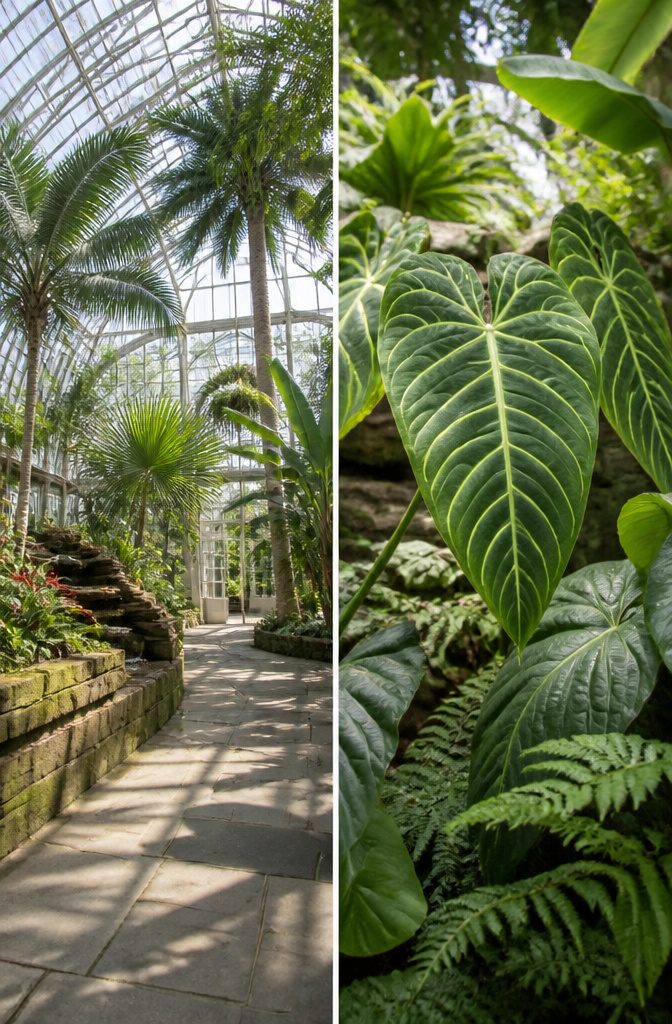
Lyman Conservatory at Smith College packs more than 3,000 species into a greenhouse complex that traces back to the early 1800s.
That plant-to-footprint ratio makes it one of the densest living collections open to the public in the country, and the age of the structures themselves, built by Lord & Burnham, places it among the oldest surviving greenhouse complexes in the US.
I would head straight for the Palm House, where a titan arum opens its gigantic flower every three to five years.
The Fern House runs a close second, with New Zealand tree ferns rising above dozens of fern species and a Wardian case tucked in.
The Camellia Corridor leads you between them, and the Warm Temperate House keeps carnivorous plants happy while the Stove House loads orchids alongside water lilies, papyrus, sugar cane, and bromeliads.
The Spring Bulb Show in March is the moment to visit if you want the place at peak bloom.
Franklin Park Conservatory
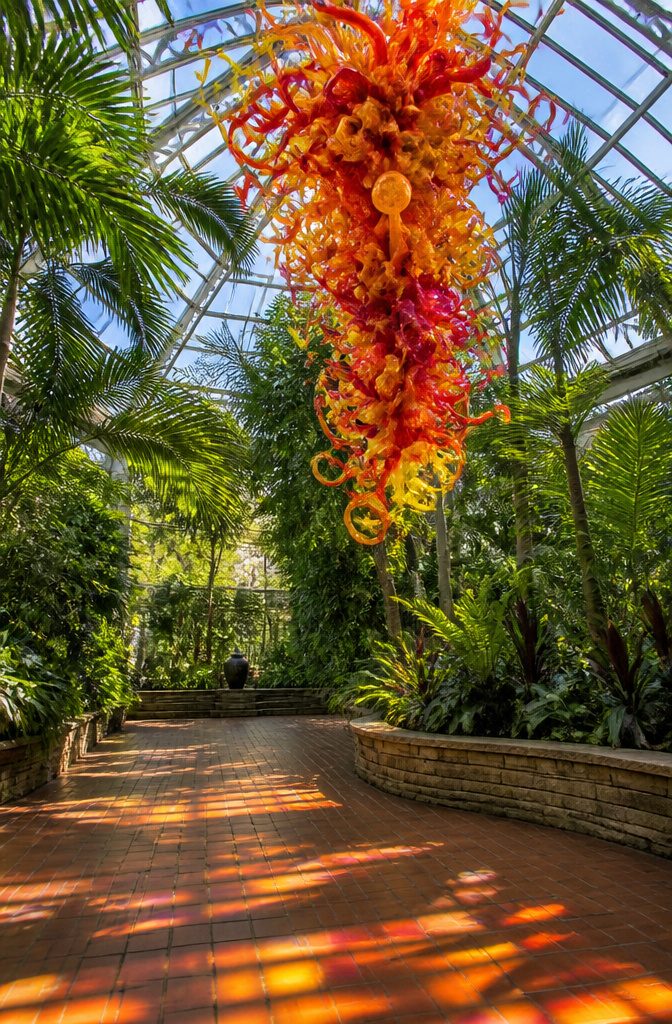
The Palm House at Franklin Park Conservatory rises with tropical palms stretching toward glass overhead, but the light does not land on leaves alone. Dale Chihuly’s glass artwork hangs throughout, catching sun and scattering color across the floor.
That pairing changes the experience entirely. In a plants-only conservatory, the eye travels slowly from leaf to leaf; here, the glass pieces arrest it first, and the greenery becomes a backdrop that softens their edges.
The Himalayan biome and Pacific Islands rooms still transport you out of Ohio winter, yet the art makes the space feel assembled rather than grown.
For a visitor chasing the lush escape that "botanical garden inside" promises, the glasswork adds a layer that pure plant collections rarely achieve, though it trades some of the wildness.
Come November, Conservatory Aglow wraps the gardens in thousands of lights that reflect off both glass sculpture and leaves, and the effect justifies the art’s presence year-round.
Cleveland Botanical Garden Glasshouse
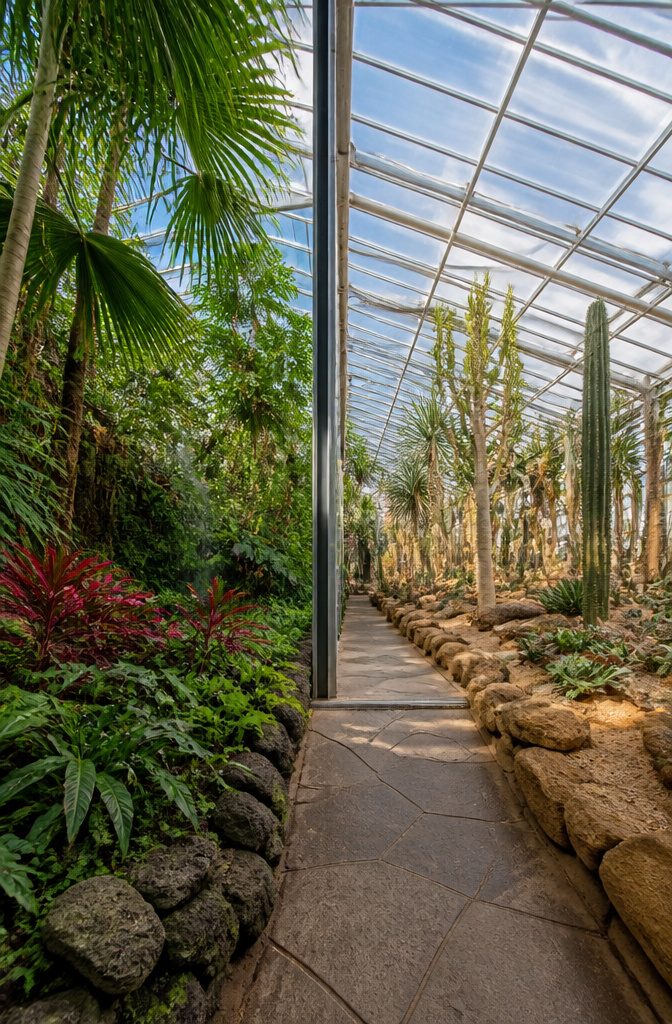
The Cleveland Botanical Garden’s glasshouse is split down the middle, and that dual-climate engineering is what makes it worth the trip.
One half holds a Costa Rican rainforest, humid and dripping, while the other replicates a Madagascar desert, dry and sun-baked.
Keeping both alive in a single building means separate HVAC systems working against each other: one side dumping moisture, the other adding it back, with thick insulation between the zones so neither climate bleeds across the wall.
I think the rainforest side wins for atmosphere. The desert is striking, but you can see dry-adapted plants in plenty of places; a cloud forest inside a Cleveland winter is the reason you came.
The cost is running expense. Maintaining two active biomes burns through energy and water bills that a single-zone conservatory avoids, and that cost was built into the construction from the first steel beam.
If you’re visiting, budget extra time for the humid half. Your glasses will fog walking in, and that’s the point.
Krohn Conservatory
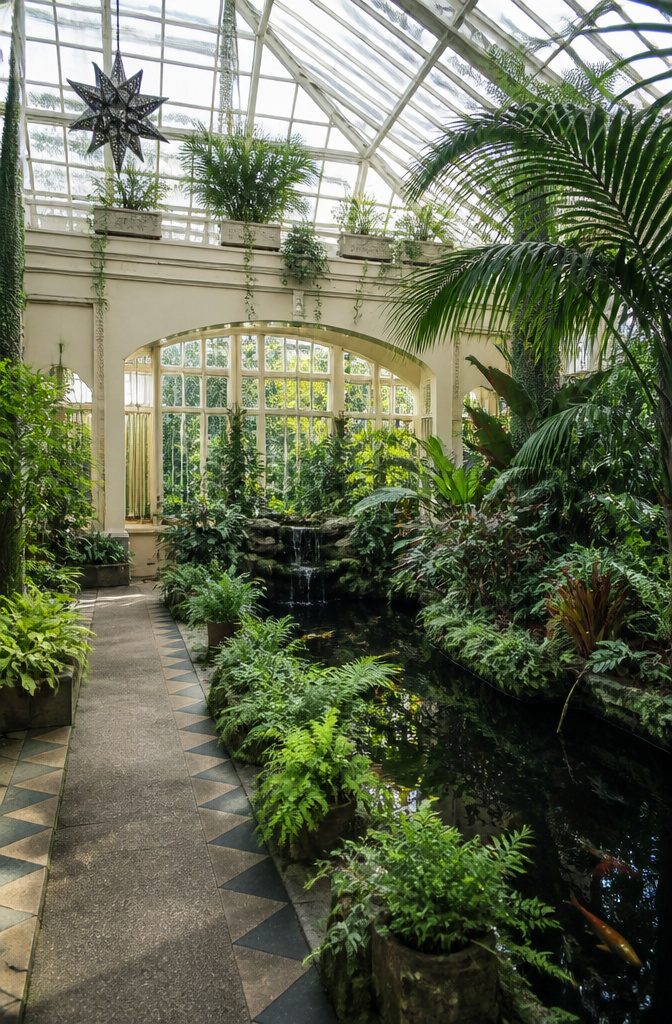
Krohn Conservatory in Cincinnati’s Eden Park has been open since 1933, and that nearly century-long run shows most clearly in the plant maturity.
The Art Deco structure itself carries the era’s clean geometry and vertical lines, but what struck me on visiting was how the permanent collections have grown into that frame rather than merely filling it.
The Palm House demonstrates this best: fruit trees and vanilla vines reach heights that only decades of stable climate control allow.
The Fern House centers on a small pond where koi move through understory that reads as established woodland, not recent installation.
Even the Desert House, where cacti and succulents grow slowly by nature, displays specimens with the heft of long cultivation.
For anyone chasing the "botanical garden inside" feeling through a gray winter, the November-to-January holiday show adds poinsettias and model trains threading miniature Cincinnati landmarks.
The seasonal layer sits on top of those permanent rooms, so the warmth feels earned rather than temporary.
The cost is size. Krohn covers its five houses in a compact footprint, so you will circle the Palm House in a few minutes.
I would not plan a full day, but for an hour of genuine greenhouse density without the admission prices of larger institutions, the maturity here justifies the trip.
New York Botanical Garden Enid A. Haupt Conservatory
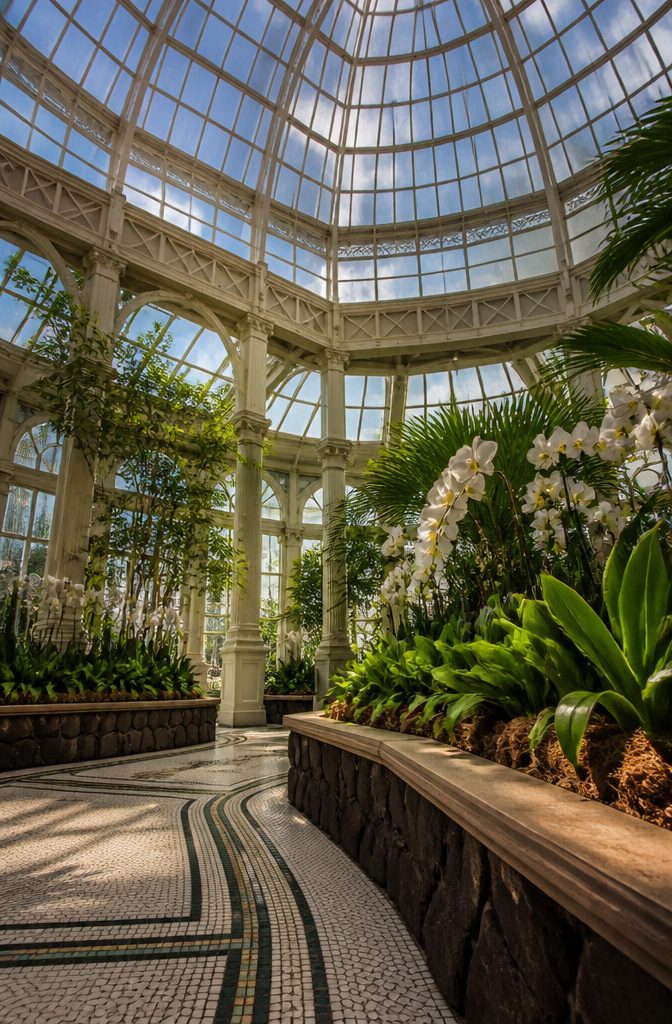
Lord & Burnham Co. designed the Enid A. Haupt Conservatory with the glass-domed silhouette that still defines it, and groundbreaking started in 1899.
That Victorian-era approach to glasshouse craft meant iron framing built to carry acres of hand-blown panes, engineering that had to breathe and bear snow loads at once. The company basically invented the American conservatory, and this is the surviving flagship.
What I find more useful than the dome itself is what happens underneath it. The conservatory runs multiple galleries with separate climates, so you can walk from a dry cactus desert into tropical humidity without stepping outside.
In practice that means zone-by-zone HVAC, misting systems, and glass panels selected for different solar gain, all hidden behind the Victorian skin.
The place is restored on a roughly twenty-year cycle, which keeps the iron and glass sound and the plant collections alive.
The annual Orchid Show opens in March, timed for when New Yorkers need the escape most.
Admission runs $35 for adults, with timed entry slots. If you are in the city and want to see how a century-old glasshouse actually functions, this is the one that shows you the mechanics along with the plants.
Brooklyn Botanic Garden Conservatories
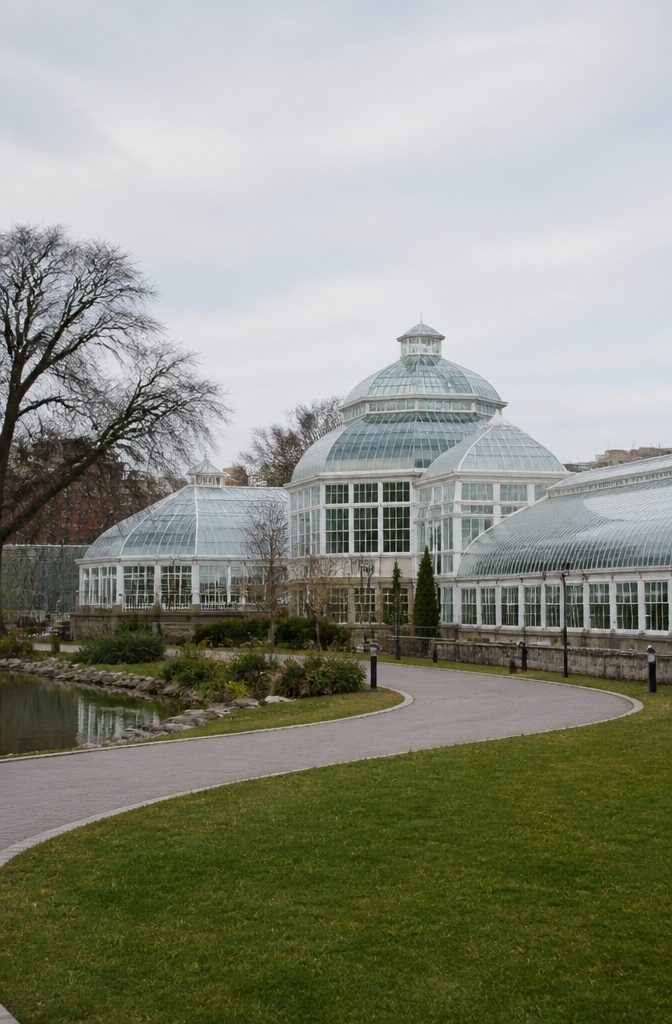
The Brooklyn Botanic Garden spreads its indoor worlds across separate glass buildings rather than one combined hall, and that choice matters.
Each conservatory locks in its own climate: the Tropical Pavilion runs humid and warm beneath a roof that peaks at 65 feet, room enough for banana plants and rubber trees to grow without hitting glass, while the Desert Pavilion keeps things dry and bright for cacti and wildflowers from arid zones around the globe.
The Aquatic House adds a third system entirely, with its own humidity needs and one of the country’s largest orchid collections kept happy beside waterfalls and pools.
This division by climate zone lets the garden grow plants that would fight each other in shared air.
A single combined space would force compromises: too damp for desert species, too dry for rainforest understories, too warm or cool for one group or another.
Separate buildings mean no such negotiation. The garden keeps each world intact, and visitors move between them like crossing continents without leaving Crown Heights.
The most ambitious and rewarding project is to create a whole room that is dedicated to gardening. The walls should be painted a light-reflecting color and may be decorated with architectural elements for an outdoor ambience. The floor should have a durable and waterproof cover.
That same principle applies at home: a dedicated plant room with waterproof flooring and light-reflecting walls beats tucking humidity lovers into dry corners. The garden just scales it up, building by building.
Longwood Gardens
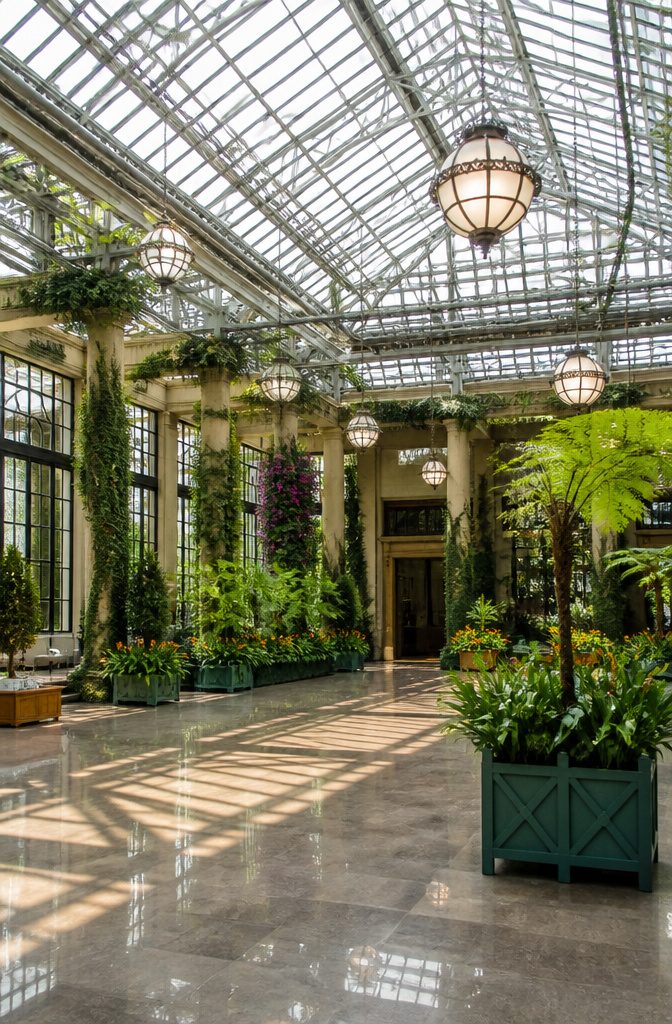
The indoor gardens at Longwood Gardens stretch across more than 10 acres of controlled environments woven through Kennett Square, Pennsylvania.
That acreage sits inside one of the largest garden systems in the country, and the scale shapes what you actually see: the Historic Main Conservatory keeps blooms going year-round, the Orchid House isolates a collection that would vanish outside, and the newer West Conservatory builds a Mediterranean landscape under glass where Pennsylvania winter would kill it in a week.
Ten acres of climate control does not maintain itself. Heating, cooling, humidity systems, and glass replacement on that footprint run into the millions annually, though Longwood does not publish exact operating figures.
What the visitor notices is the result: perpetual bloom, mature trees indoors, and seasonal displays that rotate without the weather ever dictating the schedule.
I would visit in late winter, when the contrast between the glasshouse and the dormant outdoor gardens is sharpest. The indoor portion carries the whole experience through months when the rest of the property offers little.
For someone searching "botanical garden inside," this is the definition: not a greenhouse attached to a garden, but a garden system designed to function as two parallel worlds, with the indoor one doing the heavier lifting half the year.
Hershey Gardens
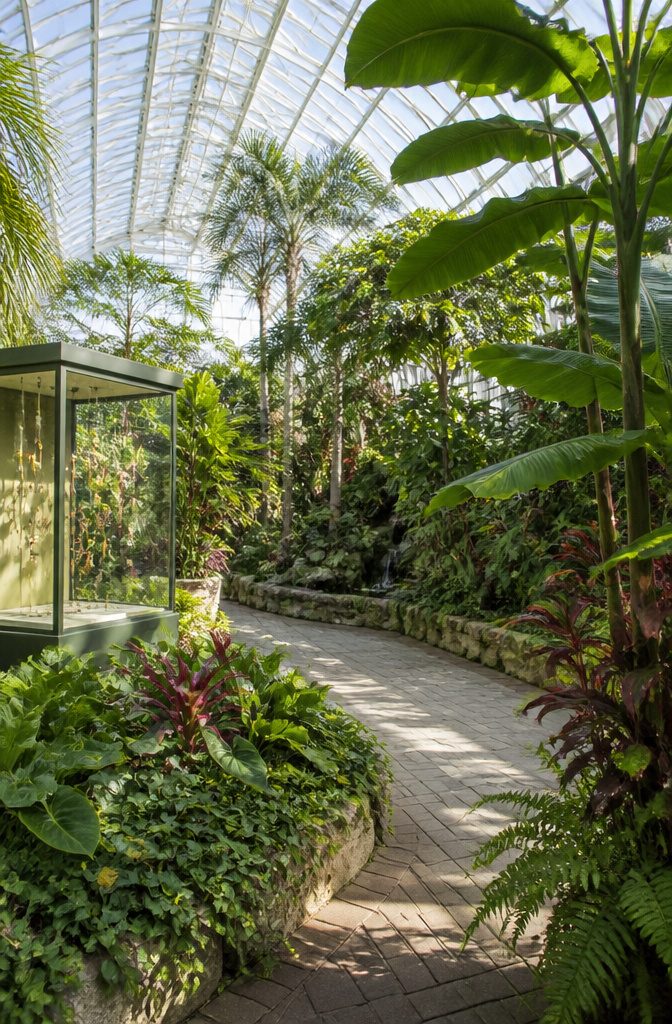
The Hershey Gardens conservatory in Pennsylvania runs a butterfly atrium year-round, and that single decision changes what you get from a winter visit.
Hundreds of North American and tropical species move through the space while palm trees, ti plants, hibiscus, and the cacao tree itself give them cover.
I would head straight for the Chrysalis Cabinet, a large display that traces the full lifecycle from egg through caterpillar, pupa, and adult. It turns a pretty walk into something you actually remember.
The tropical house stands as its own experience, not merely a backdrop for the butterflies. The same plantings that feed and shelter the insects create a dense tropical setting that reads as genuine habitat rather than staging.
For anyone driving in from the mid-Atlantic during the colder months, this matters: the greenhouse effect here is literal, and the contrast with frozen parking lots outside is part of the draw.
I count the butterfly house as the stronger of the two indoor spaces, but the tropical house earns its keep by extending the visit without feeling like filler.
Isabella Stewart Gardner Museum Courtyard
The Isabella Stewart Gardner Museum in Boston takes a different approach than every other stop on this list.
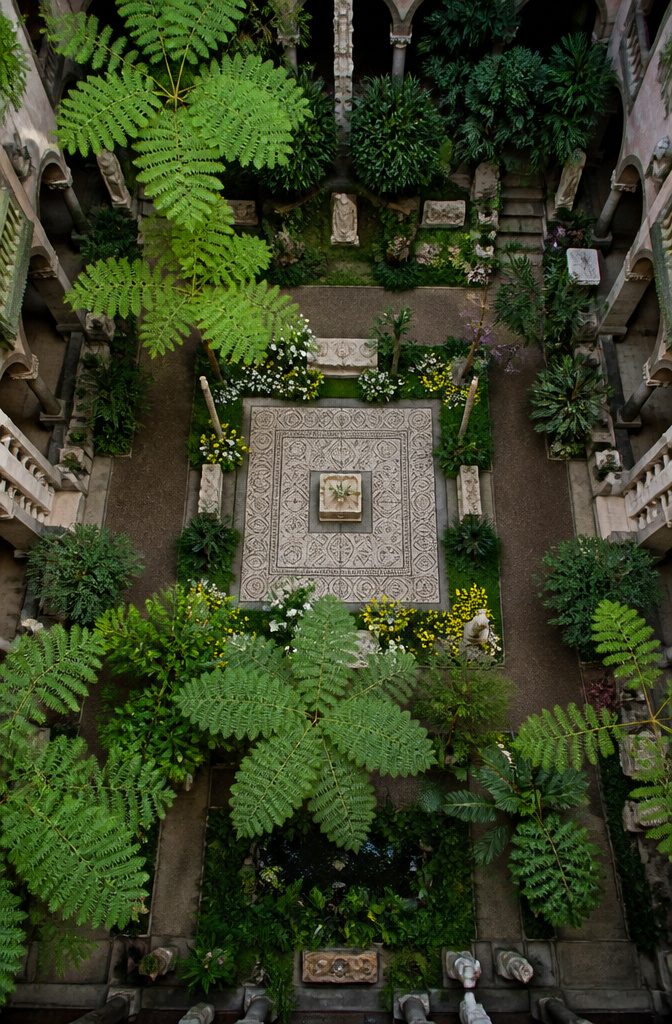
Its central courtyard garden sits inside a building designed in 1903 for art and music, not plants. Where purpose-built conservatories engineer glass and climate from the ground up, this space works backward: a garden retrofitted into an existing palace.
That constraint shapes everything you notice. The courtyard fills with tropical green from January through February, Norfolk Island pines and tree ferns layered with jade plants in cloud-like white bloom.
By late February, the display shifts to weeping yellow jasmine and dozens of orchids, lady’s slippers and moth orchids among them.
The nasturtium display in spring is the signature moment, but the real lesson is how the architecture forces intimacy. The four stories of balconies press close; you are not walking through a garden so much as leaning over one.
For a renter or homeowner thinking about an indoor garden, this is the proof that a conservatory’s scale or systems are optional. The Gardner did it with a courtyard, skylights above, and the humidity that Boston already supplies in summer.
The cost is control. You cannot dial in humidity or swap glass for polycarbonate; you live with what the masonry gives you.
Logee’s Greenhouses
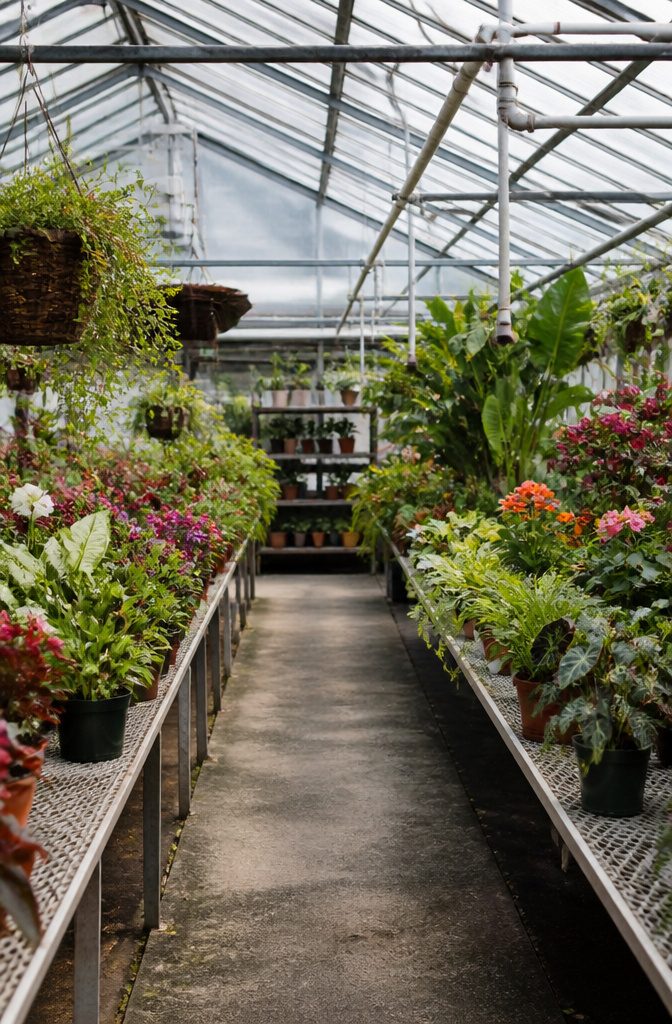
Logee’s in Danielson, Connecticut runs a working commercial greenhouse that still lets visitors walk through, though the experience sits closer to retail than to a public garden.
The shift matters for what you will actually see. A conservatory built for display keeps plants staged for effect; a greenhouse built for propagation keeps them lined up for light and airflow, and that is the logic here.
The draw is the stock itself. The Ponderosa Lemon tree that founder William D. Logee bought in 1900 still grows in the original greenhouse, still producing five-pound fruit, and thousands of lemon trees have been propagated from it since.
The current collection leans into tropical and exotic plants: passion flowers, Angel’s Trumpets, orchids, begonias, jasmines, citrus.
What you are walking through is basically the showroom for a mail-order nursery, which means the plants are healthy, labeled, and for sale, but the arrangement is functional, not assembled for photography.
For a renter or weekend project type, this is a useful distinction. Logee’s rewards someone who wants to inspect a passion flower up close, ask why one citrus variety roots differently than another, and carry a plant home.
It does not reward someone chasing the glasshouse aesthetic for a mood board. The cost is real: living inventory over designed experience, and prices that reflect nursery stock rather than admission tickets.
Meyers-Deats Conservatory
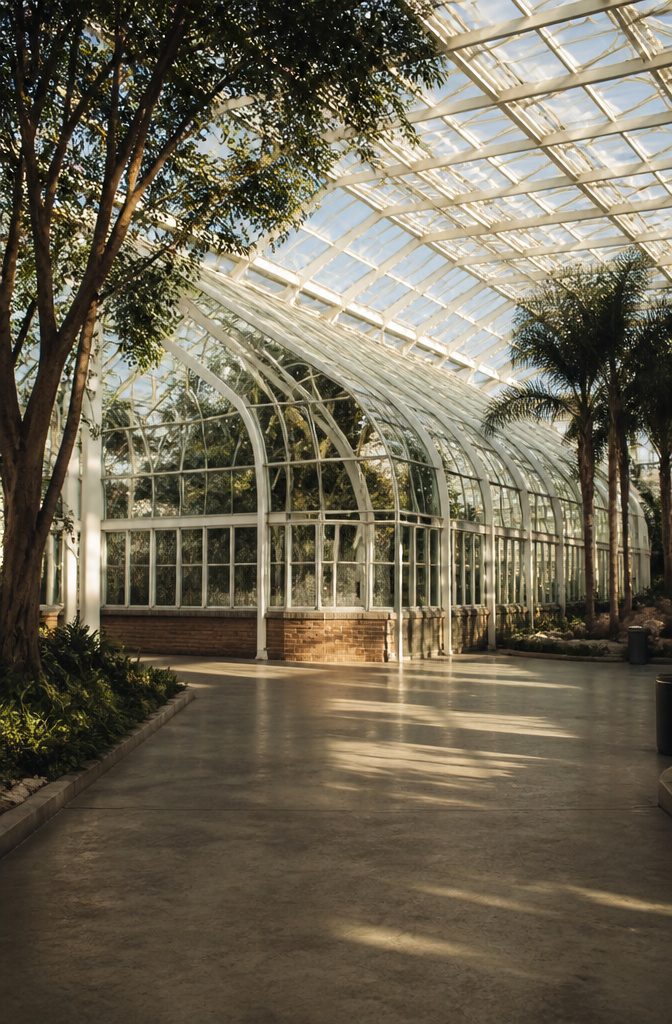
An arboretum lives outdoors by definition, so the Meyers-Deats Conservatory at the Minnesota Landscape Arboretum answers a question cold-climate gardeners ask every February: where do the trees go when the ground is frozen three feet deep?
The answer is a glasshouse built for woody plants that cannot survive a Minnesota winter, not just a temporary shelter for tender ornamentals but a permanent collection of species that would otherwise be impossible to grow in the upper Midwest.
The justification is practical, not decorative. The arboretum’s outdoor mission, documenting and displaying trees and shrubs hardy to zone 4, leaves entire genera unavailable to local visitors.
The conservatory fills that gap with tropical and subtropical specimens, understory plants, and the sort of mature canopy architecture that takes decades to develop.
You walk in for the temperature change and stay for the vertical scale: trunks that rise to a glass ceiling, something no tabletop fern collection can replicate.
I would time a visit for late morning in January, when the contrast between the gray outside and the humid green inside is sharpest.
The admission runs with the main arboretum gate, so the cost is already sunk if you planned a winter walk; the conservatory becomes the reward for making the drive in snow.
Marjorie McNeely Conservatory at Como Park
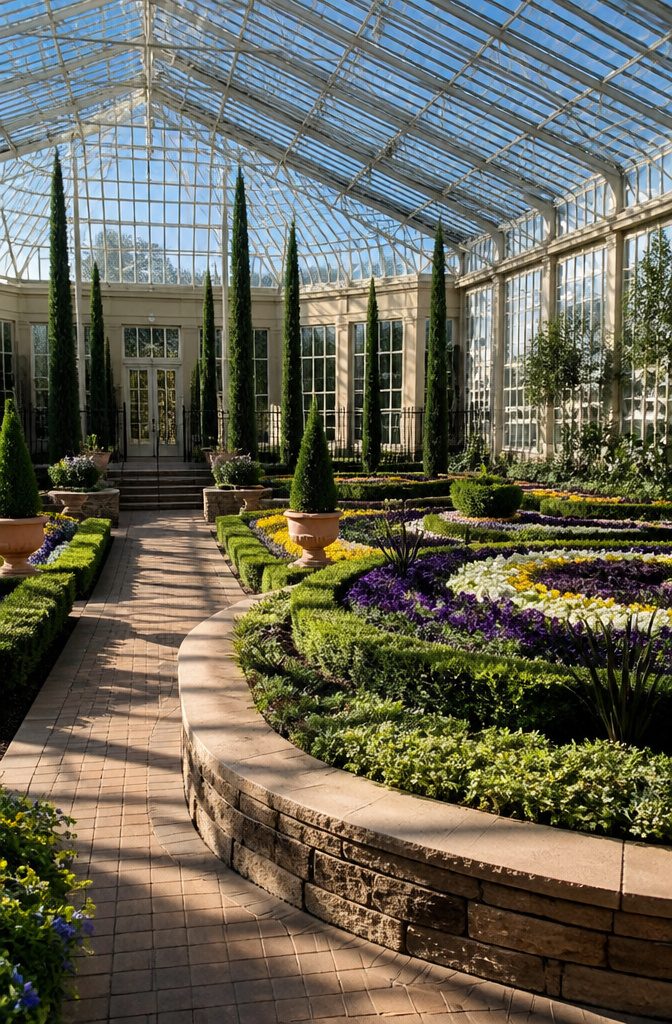
The sunken garden room at the Marjorie McNeely Conservatory is the space that justifies the drive across the river from Minneapolis. You descend into a formal European-style parterre kept in bloom year-round, a layout that feels theatrical without being precious.
The geometry of the beds matters here; the conservatory staff reset the plantings for each seasonal flower show, so the room reads differently in February than it does in August.
The flower shows are the reason I would time a visit rather than drop in casually.
The conservatory runs them on a reliable calendar, and the winter show in particular solves the problem that sends most people searching for a "botanical garden inside" in the first place: something blooming while snow covers everything outside.
The Japanese Garden exists here too, dedicated to the Saint Paul–Nagasaki sister-city relationship, but it plays second fiddle unless you are specifically after that aesthetic.
Trade-off to note: Como Park is a public park first, which means weekend crowds and the occasional school group echoing off the glass. Arrive at opening if you want the sunken garden to yourself for photography.
Stan Hywet Hall & Gardens Conservatory
The Stan Hywet estate in Akron, Ohio, carries the full weight of Gilded Age ambition.
Built during the 1910s for F.A. Seiberling, the co-founder of Goodyear Tire & Rubber, the mansion and its grounds were conceived as a private retreat on the scale of European nobility.
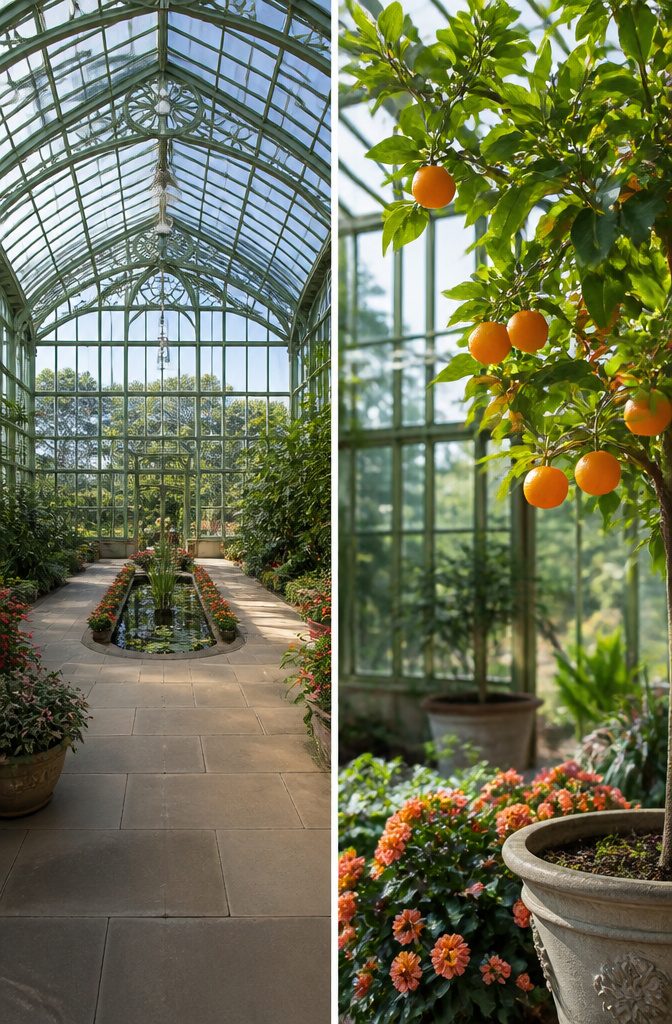
The Corbin Conservatory, with more than four thousand panes of glass, served that household directly: citrus and tropical plants grown under its roof supplied the estate kitchen and decorated its rooms year-round.
This was never a public pleasure garden in its original life. The greenhouse operated as working infrastructure for a single family, maintained by staff who managed propagation, heating, and the careful choreography of seasonal displays.
That private-to-public conversion, completed decades after the Seiberlings’ residence, shapes what visitors encounter now. The Palm House still holds tropical plantings and rotating seasonal color, but the context has shifted from service to spectacle.
For a reader weighing whether to make the trip, the honest trade-off is this: the conservatory’s scale is modest compared with dedicated botanical institutions, and its collection serves historical interpretation as much as horticultural depth.
What it offers instead is intact atmosphere. The glass structure, the scent of greenery overhead, the surviving layout of a servant-passage economy behind the grandeur, these read as a complete period room rather than a plant museum.
Go for the immersion in how the very wealthy lived with growing things, not for the widest species variety.
Butterfly Conservatory at the Museum of Natural History
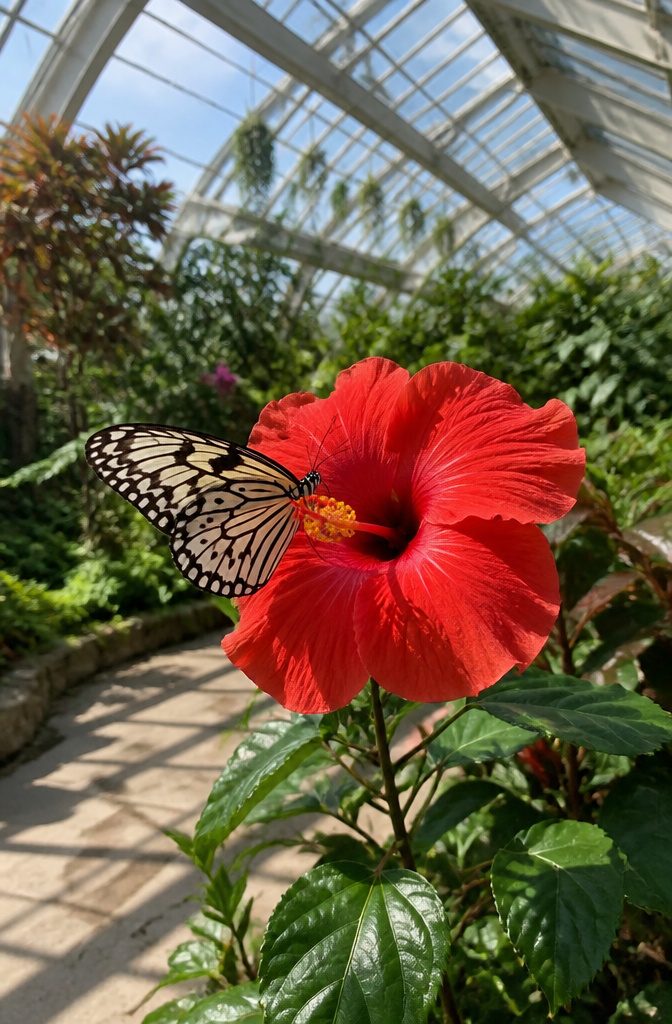
The American Museum of Natural History runs a tropical vivarium kept at 80 degrees to support its live collection of up to 80 butterfly species and several moths.
That temperature requirement changes everything about how the building operates compared to a plant-only conservatory.
Live insects need strict humidity control, filtered light that won’t overheat delicate wings, and entry systems that prevent escapes, all layered on top of the plant support systems you’d find in a standard glasshouse.
Visitor rules shift too. The museum issues ID cards so guests can identify species as they move through, and a pupae incubator lets you watch adults emerge from chrysalises.
Hold still, and butterflies may land on you, though touching their wings is prohibited. The experience trades the contemplative pacing of a plant conservatory for something more participatory and tightly choreographed.
Admission runs $30 for adults, with New York residents eligible for pay-what-you-wish entry with valid ID. The butterfly vivarium requires a separate ticket on top of general museum admission, so factor that into your budget before you commit.
Plant Types and Climate Zones
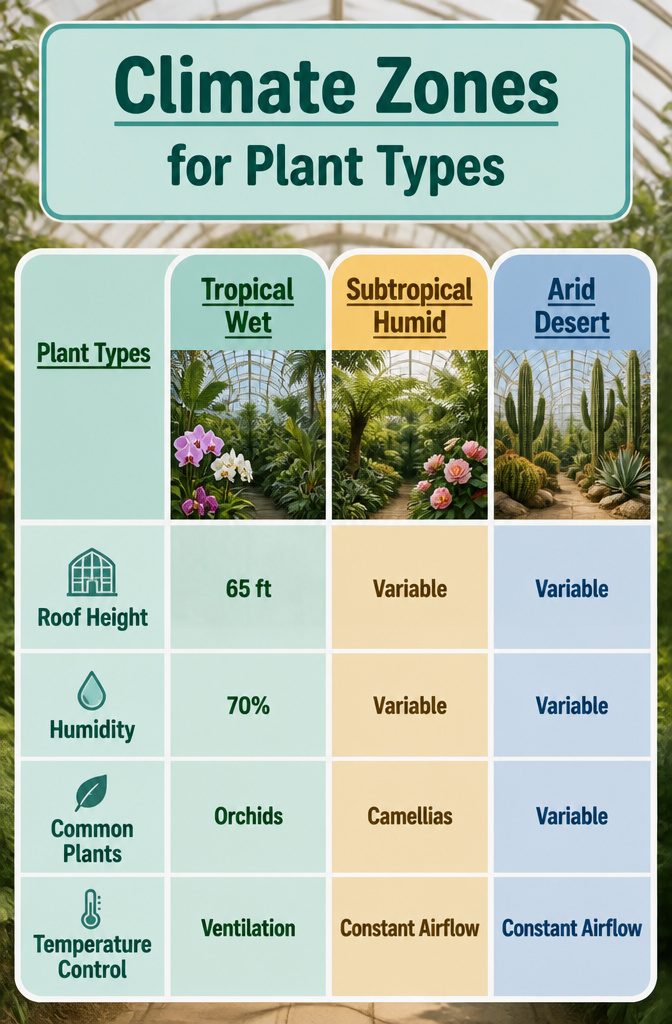
A conservatory’s plant collection starts with the climate it can actually maintain, not the wish list of every species on earth. Most of the major American conservatories run three core zones: tropical wet, subtropical humid, and arid desert.
The engineering gets specific fast. Tropical houses need 65-foot roofs to clear emergent trees like rubber and banana; the glass has to vent without dropping humidity below the 70 percent orchids need to set bud.
At the other extreme, desert pavilions move air constantly to prevent rot in cacti that would rather take 40-degree swings between day and night than sit in stagnant warmth.
The subtropical range is where most visitors linger longest, probably because it feels less extreme.
Camellias, tree ferns, and carnivorous plants all live in that middle band, though they rarely share the same house; the Wellesley model splits even its dry biome into continental deserts and Mediterranean chaparral. I find the precision telling.
A conservatory isn’t a greenhouse with prettier walls. It’s a set of machines pretending to be latitude and altitude, and the plants survive only where the pretense holds.
Seasonal Events and When to Visit
The best indoor gardens do not sit empty in February waiting for spring.
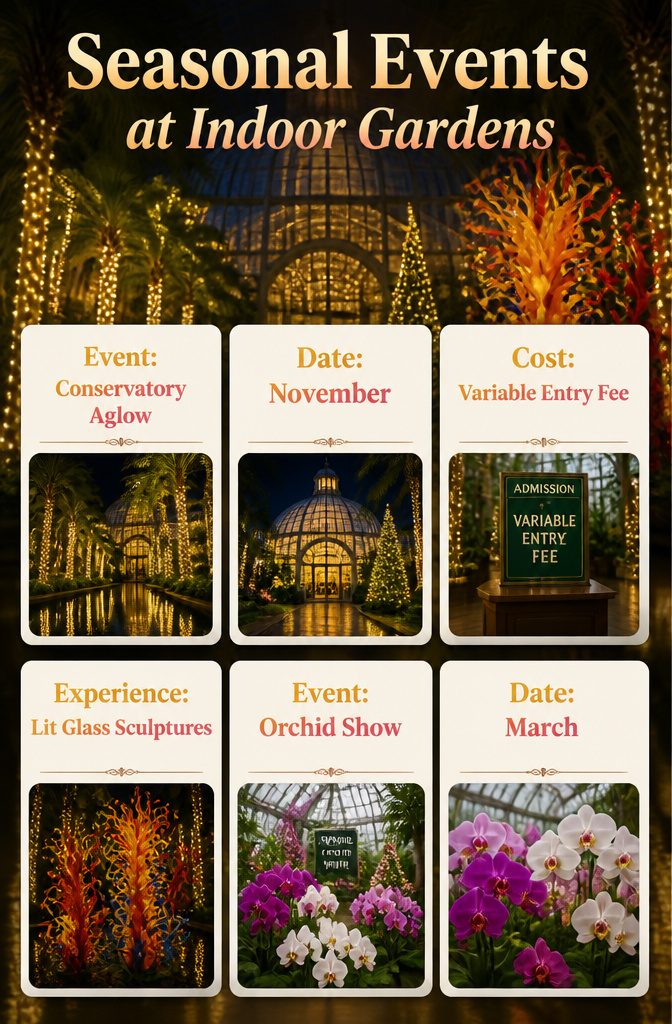
Franklin Park Conservatory strings thousands of lights through the Palm House each November for Conservatory Aglow, turning the glass ceiling and Chihuly sculptures into a reflected glow that justifies the trip past dark.
The New York Botanical Garden waits until March, when its Orchid Show fills the Victorian glasshouse with thousands of orchids arranged to a new theme each year.
Winter is when these spaces earn their keep. Outdoor gardens in Columbus or the Bronx are dormant or mud, but the indoor biomes stay at rainforest humidity and desert dryness regardless.
A visitor steps out of Ohio cold into Pacific Island warmth, or out of late-winter gray into March orchid color, and the contrast is the point.
I would plan around the events if the dates work, but the deeper value is the season itself. January through March is peak season for indoor botanical gardens because the outside is doing so little.
Conservatory Architecture and Glass
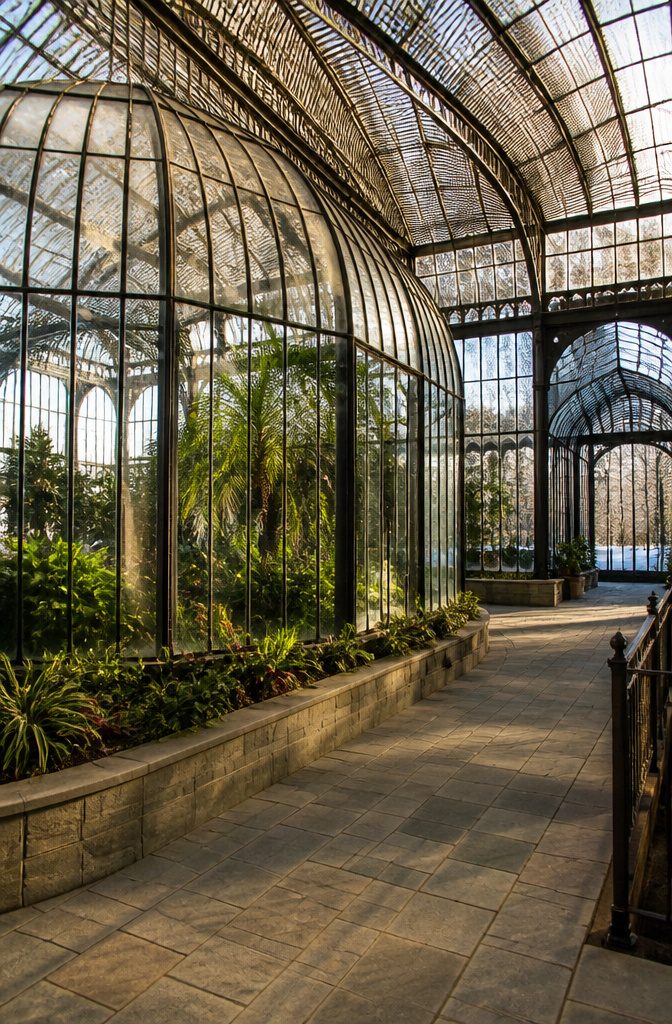
Lord & Burnham’s Victorian glasshouses run on iron ribs and thousands of hand-rolled glass panes. The metal frame conducts heat straight out into winter air, and the single-pane glazing does almost nothing to stop it.
A building like that can lose heat five or six times faster than your home does, which is why historic conservatories spend fortunes on boilers and still run cool in January.
The 1930s Art Deco frames swapped iron for steel and started using wire-reinforced glass. The wire mattered less for structure than for looks, but the frames did get slimmer and the glass slightly better sealed.
Heat loss dropped, though not dramatically; these buildings still need serious heating budgets to keep tropical plants alive in Cleveland or Saint Paul.
Modern 2019 construction is a different species entirely. Aluminum or thermally broken steel carries the load, and the glazing is insulated glass with low-e coatings that reflect infrared back inside.
The same square foot of wall might lose a third of the heat it would in a Lord & Burnham house, and the annual fuel bill shows it.
If you are visiting, the architecture tells you what to bring. Victorian houses stay chilly near the glass, so a sweater matters even in July.
Modern ones feel more like shopping-mall climate control. The operating budget explains the ticket price, too: older conservatories cost more to run, and that shows up somewhere.
Frequently Asked Questions
What are the best indoor botanical gardens to visit?
Top picks include Wellesley College’s Global Flora Conservatory for its climate-grouped biomes, the 12,000-square-foot Roger Williams Park Botanical Center in Providence, and the 1899-built Enid A. Haupt Conservatory at the New York Botanical Garden.
Each offers a different experience: ecosystem education at Wellesley, walking room and fountains at Roger Williams, and historic glasshouse craft in the Bronx.
What types of plants can be found in indoor gardens?
Indoor botanical gardens grow tropical palms and rainforest understory, desert cacti and succulents, subtropical humidity lovers, and Mediterranean species.
Are there any seasonal events at these gardens?
Yes.
The New York Botanical Garden’s Orchid Show opens in March, Krohn Conservatory runs a holiday show from November through January with poinsettias and model trains, and Franklin Park Conservatory’s Conservatory Aglow wraps the gardens in thousands of lights each November.
Smith College’s Spring Bulb Show in March is another timed opportunity.
What makes a garden a botanic garden?
A botanic garden maintains documented living collections for scientific study, conservation, and public education, not just display.





