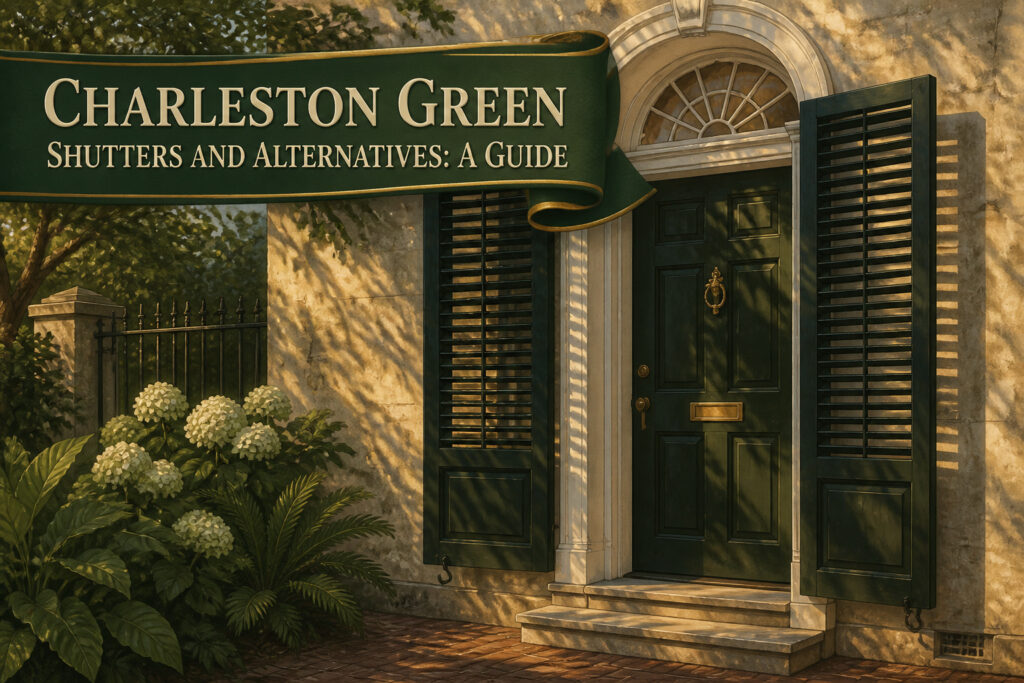
Charleston Green is a near-black green paint color, hex roughly #23312A, that reads as flat black from across the street and only reveals its deep forest undertone up close or in raking light. The catch is its LRV of 4 to 6: dark enough to make trim and brick look richer than true black allows, but so light-absorbing that it behaves like a heat sink on anything larger than a shutter or door. That low reflectance is why you see it on Charleston Historic District shutters and piazza ceilings rather than whole houses, and why the sheen you choose, satin to semi-gloss at minimum, determines whether the green survives at all.
[link-whisper-related-posts]Charleston Green
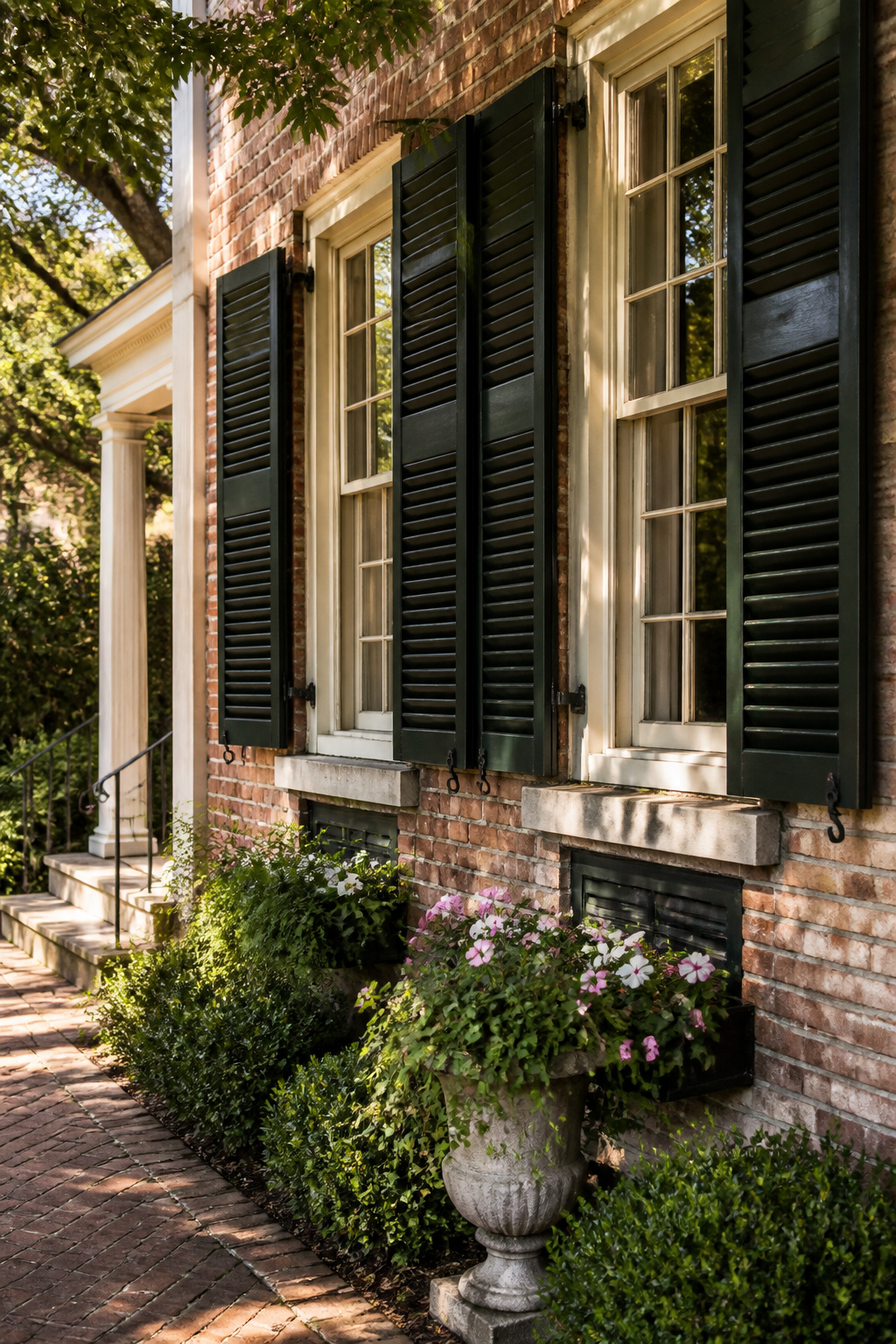
The almost-black green you see on Charleston shutters is Charleston Green, a color that reads as flat black from across the street and only resolves into deep forest-green up close or in raking light. Approximate hex #23312A, RGB near 35, 49, 42. That very low LRV of 4 to 6 is what makes it work on shutters: it absorbs enough light to read as a near-black from distance, so your trim and brick look richer rather than harsh, but the green undertone keeps it from going dead-flat like true black can. I have seen it beside a door painted in straight black, and the difference is subtle until the afternoon light hits; then the Charleston Green door gains depth while the black one just sits there. For a weekend project on a few hundred dollars, that small warmth matters, because you are not hiring someone to repaint when the color turns out too cold against your brick.

Ready to use, pre-mixed door and trim paint offers a fresh new look on interior or exterior metal, wood and fiberglass
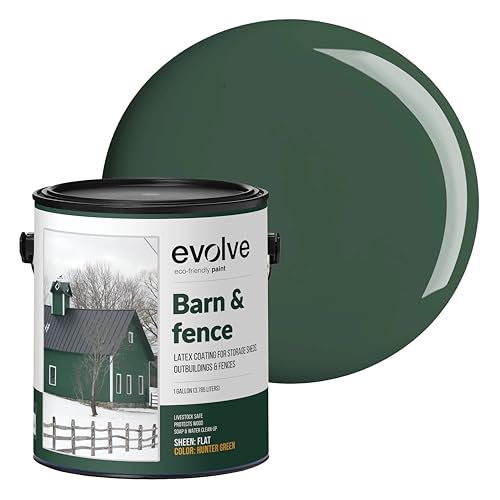
ELEVATE OUTDOOR STRUCTURES: Refresh barns, fences, sheds, and exterior surfaces with durable paint that delivers long-lasting color and protection.
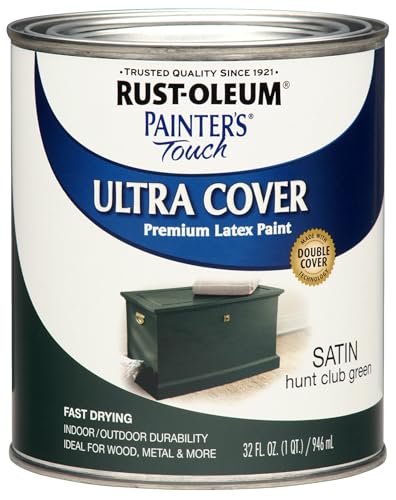
Use for a variety of indoor and outdoor project surfaces including wood, metal, plaster, masonry or unglazed ceramic
Essex Green
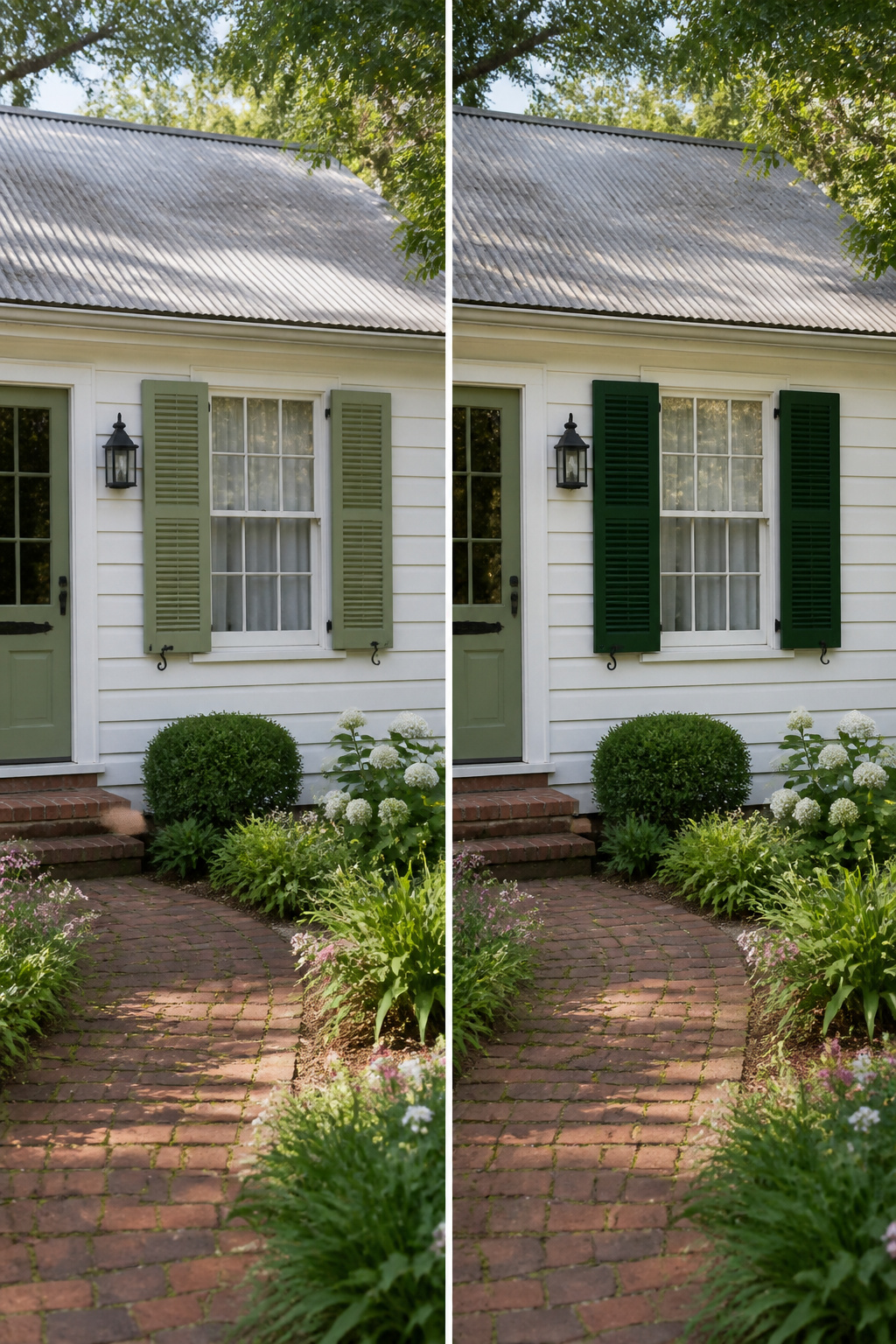
Benjamin Moore Essex Green reads slightly more recognizably green at a distance than Charleston Green itself, which makes it the closest off-the-shelf match in their line for anyone who cannot source the original. The difference is subtle up close, but from the sidewalk or across the street, that extra bit of green shows through the black base in a way Charleston Green often does not.
Essex Green is the classic shutter green most painters reach for when a homeowner asks for Charleston Green and the local store does not carry a custom match. I have seen it hold up well on exterior shutters in direct sun, where the pigment depth keeps it from flattening out to pure black the way some dark greens do. For a true period look, the store can still custom-match approximately #23312A in Aura Exterior or Regal Select Exterior if you bring the code.
This product is Non-toxic

Designed to provide a non-reflective finish that conceals hunting and sporting equipment

V3E Black Forest Green Touch-Up paint Compatible with Genesis models. Paint2Fix Touch-Up Paint prevents rust and is easy to apply. You can't go wrong, just remove the touch-up paint with our patented Touch-Up Paint Remover and try again.
Black Forest Green
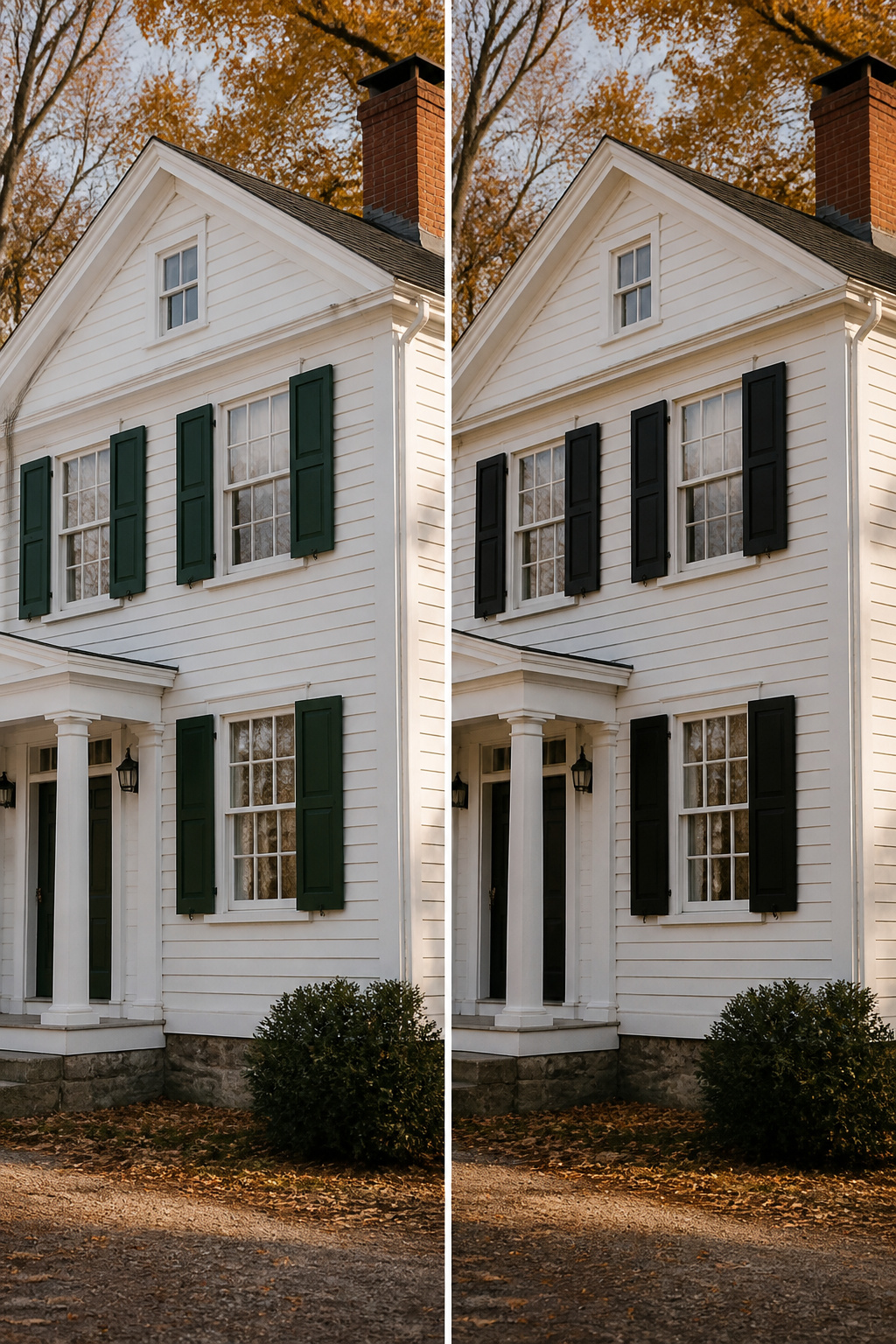
Benjamin Moore Black Forest Green 2047-10 sits darker and more black-leaning than Essex Green, close enough to Charleston Green that the two read nearly identical once the sun drops. I noticed this flipping between fan decks on a gray afternoon: where Essex Green still holds some forest, Black Forest Green flattens toward charcoal with that faint cool cast.
The choice between them comes down to what hits the shutter. Essex Green keeps its depth in direct light, so a south-facing window with strong sun gives it somewhere to go. Black Forest Green works better where light is already scarce, or where the surrounding trim runs warm. A cream clapboard or brick with orange in it will push Essex Green toward Christmas; Black Forest Green absorbs that warmth and stays quiet.
Low light is where the match tightens. In shadow, Black Forest Green 2047-10 and Charleston Green become almost interchangeable, the kind of near-black green that reads as architectural detail rather than color statement. For an exact match, a Benjamin Moore store can custom-blend to approximately #23312A in Aura Exterior or Regal Select Exterior, but off the shelf this is about as close as the line gets.

Ideal for use on interior/exterior surfaces including wood, plastic, plaster, metal, masonry and unglazed ceramic

Ideal for use on interior/exterior surfaces including wood, plastic, plaster, metal, masonry and unglazed ceramic

Weather and corrosion resistant coating protects exterior/interior surfaces like wood, metal, concrete, masonry and more
Dard Hunter Green
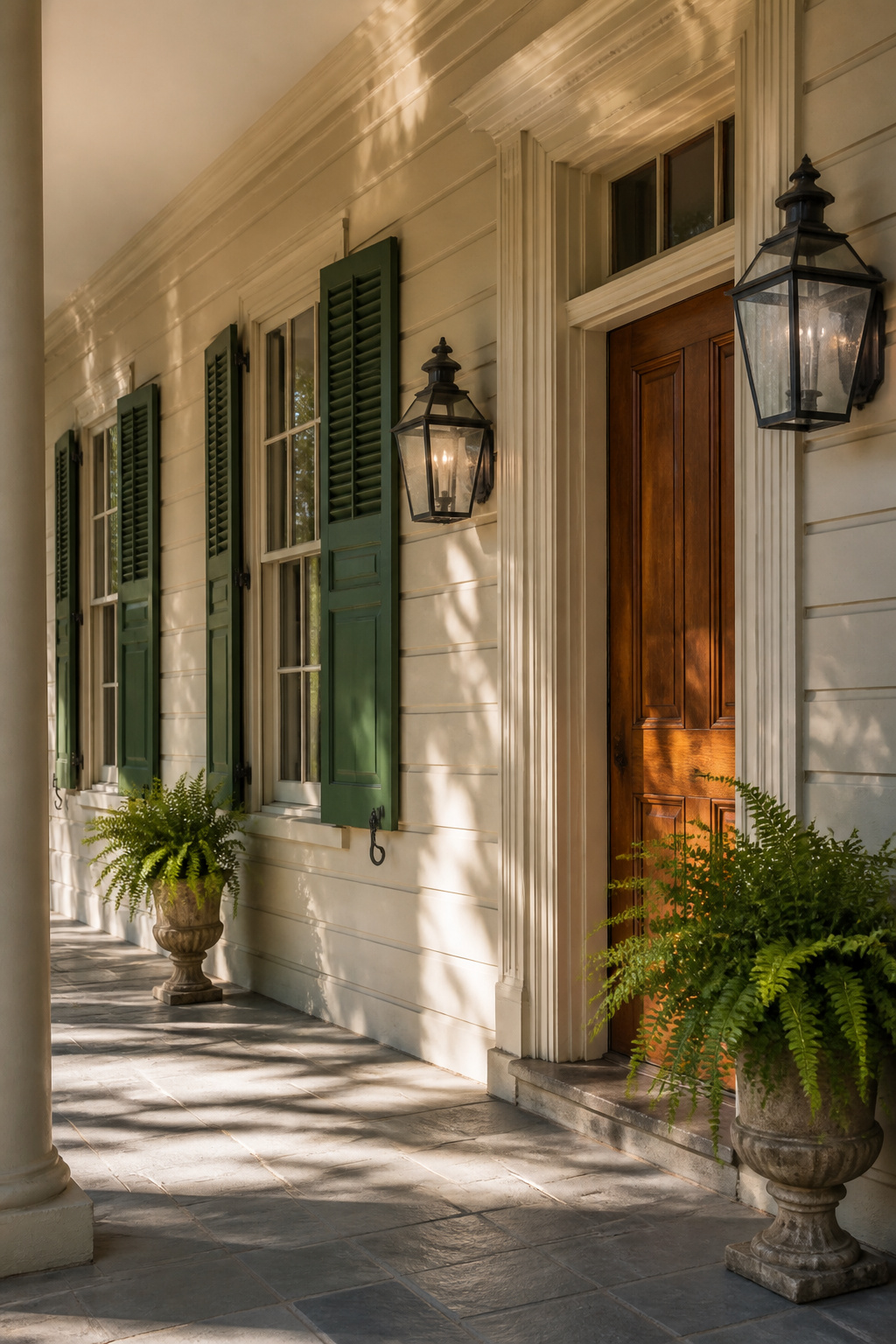
Sherwin-Williams Dard Hunter Green SW 0041 sits in the historic color collection as the closest off-the-shelf stand-in to Charleston Green, though it reads a touch greener and carries a lower-gloss feel than the traditional near-black. For shutters, that slight shift matters: the green character becomes visible at closer range while still holding the deep, period-appropriate depth from the street.
I would not pair this with a high-satin door in the same view. The finish difference would make the shutters look flatter than they are. Better to keep the sheen consistent across the elevation or commit Dard Hunter Green to the shutters alone and let a door carry the gloss elsewhere if that is the look you want.
Any Sherwin-Williams store can spectrophotometer-match the Charleston Green tradition to a custom formula in Duration or Emerald exterior at high accuracy, so Dard Hunter Green functions as a practical starting point rather than a compromise. It gets you into the historic range without the wait or cost of a custom mix, and the off-the-shelf availability wins for weekend timelines where the paint needs to be on the brush Saturday morning.

Item Description: 14 3/4"W x 55"H Lifetime Vinyl, Standard Two Equal Panels, Raised Panel Shutters, w/Installation Shutter-Lok's & Matching Screws (Per Pair), Black

This product is Non-toxic
Item Description: 12"W x 35"H Lifetime Vinyl, Standard Two Equal Panels, Raised Panel Shutters, w/Installation Shutter-Lok's & Matching Screws (Per Pair), Black
Rookwood Shutter Green

Sherwin-Williams Rookwood Shutter Green SW 2809 sits slightly warmer and more clearly green than the near-black Charleston Green tradition. Where Charleston Green can read as a dark neutral that happens to have green DNA, Rookwood Shutter Green lets the color show up from across the street.
That warmth matters on actual shutters. Charleston Green’s cooler, blacker cast can flatten into a silhouette against light siding, especially in overcast coastal light. Rookwood Shutter Green keeps enough yellow in its base to catch late-afternoon sun and still register as green rather than as a dark hole in the facade. On the Lizzie Borden House, built in 1845, the color reads as a deliberate green choice paired with green siding rather than as a near-black accent.
For a weekend project on a real budget, this difference is practical. Charleston Green demands careful pairing; put it against a cool gray or a bright white and it can look muddy or simply black. Rookwood Shutter Green forgives more siding colors because its warmth creates clearer contrast. If your house already leans warm, brick or tan or cedar, this is the easier path to a historic-looking shutter without the color turning to mud in shade.

Use for a variety of indoor and outdoor project surfaces including wood, metal, plaster, masonry or unglazed ceramic

Weather and corrosion resistant coating protects exterior/interior surfaces like wood, metal, concrete, masonry and more

【Add Fashion & Prection】: Protecting your door cups is fast and simple with our Door Cup Paint Protection film which is made of carbon fiber material. Our product can protect your door handle cups from scratches and scuffs, keeping your vehicle pristine with minimal effort or technique. With modern carbon fiber texture design, it can also improve your car's appearance.
Fine Paints of Europe Charleston Green
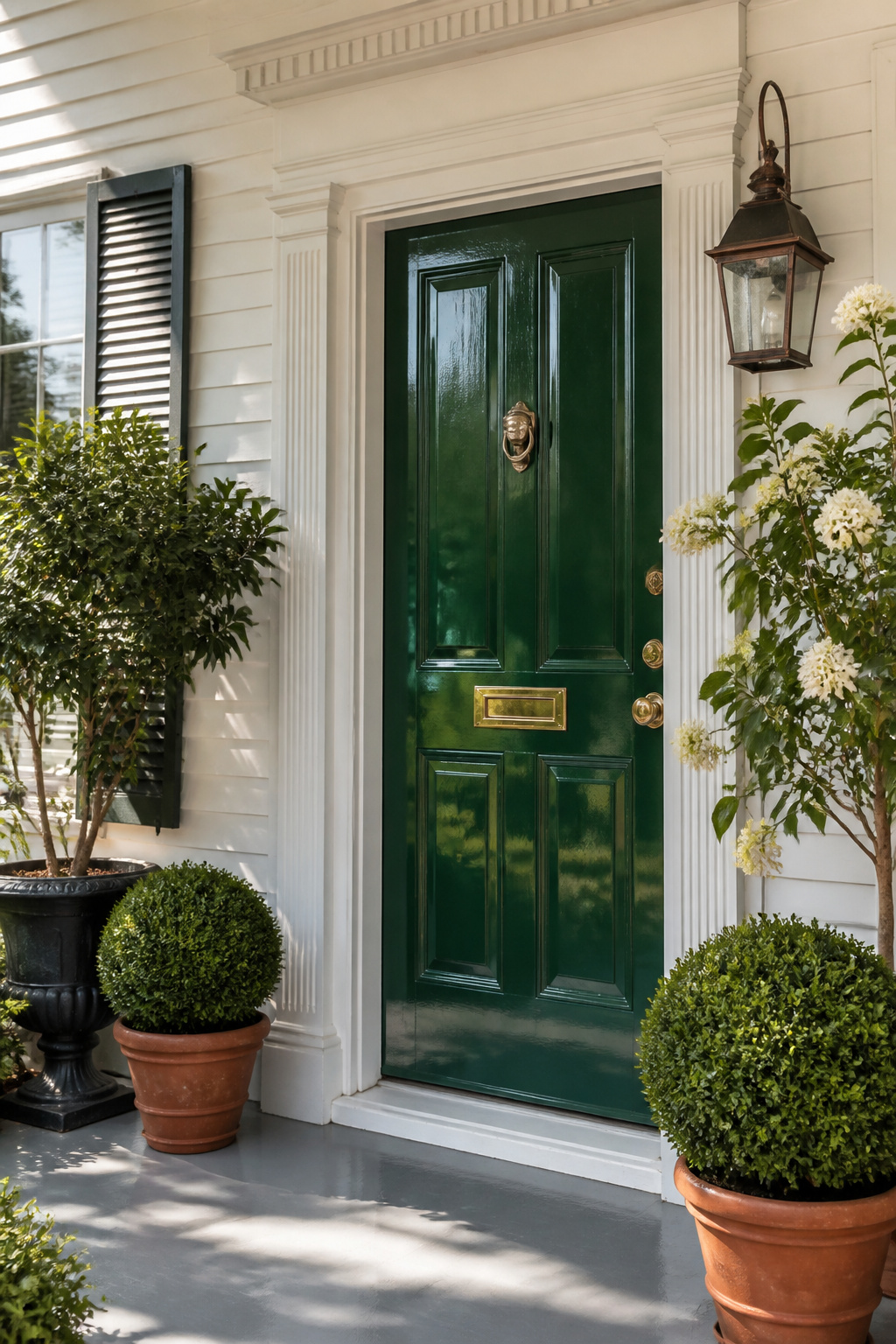
The most period-accurate take on this color comes in Hollandlac Brilliant, a high-gloss alkyd enamel that reads like wet stone in direct sun. The pigment sits deep in the resin rather than floating on top, so the black-green shifts toward forest only when the light hits it squarely, which is exactly what the Historic District doors are doing when you walk past them on a June morning.
For a restoration project, this is the paint to chase down. The mirror finish and the depth of the color are what make a Charleston door read as belonging to the 18th century rather than reading as "dark green." Sourcing it means mail-ordering through a Fine Paints of Europe dealer, waiting on shipping, and paying roughly three times what a gallon of premium latex costs at the hardware store. That cost and that wait matter less when you’re matching existing woodwork or working within a preservation review.
On new shutters or a new door, the same paint is harder to justify. The gloss level will show every brush mark and every speck of dust for weeks after application, and the alkyd cure time means keeping the surface untouched for days. A waterborne acrylic in the same color family will read as Charleston Green from the sidewalk and let you finish the job over a weekend.
Easy-to-use, one-step

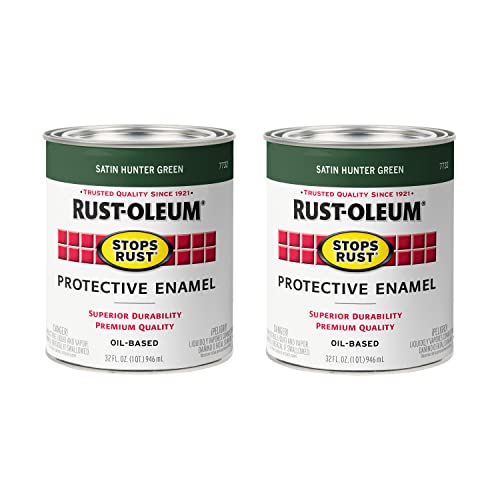
Weather and corrosion resistant coating protects exterior/interior surfaces like wood, metal, concrete, masonry and more
Where Charleston Green Came From
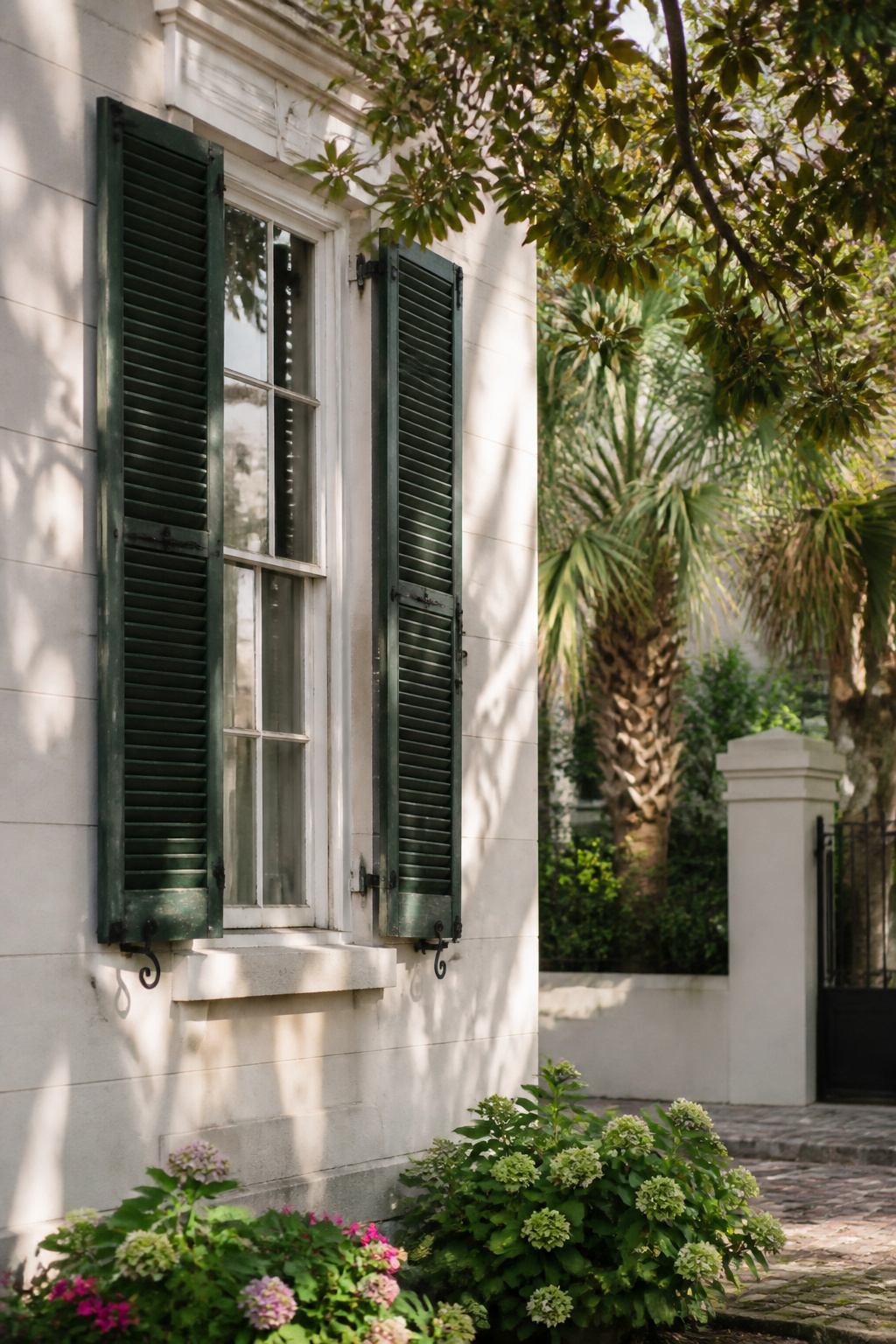
The origin of Charleston Green sits somewhere between documented history and the kind of local legend that gets repeated on walking tours until it hardens into fact. What the sources agree on is this: after the Civil War, the federal government supplied black paint to a war-damaged South, and Charleston residents found the straight black too severe for their purposes. They cut it with green and a touch of yellow, softening it into something that read as near-black from the street but revealed its green undertone up close.
That mixture became the signature color of the Historic District’s shutters, gates, and piazza ceilings, where it often paired with the lighter "haint blue" overhead. There is no single registered formula for Charleston Green the way there is for a numbered fan-deck color. Each major brand has interpreted the tradition differently, which is why the hex values and product names shift depending on whose swatch you pull. The test of authenticity is visual, not technical: near-black at a distance, deep green in the hand. If a sample reads as a clear, recognizable green from ten feet away, it is too light to be the real thing.
How Charleston Green Behaves in Light
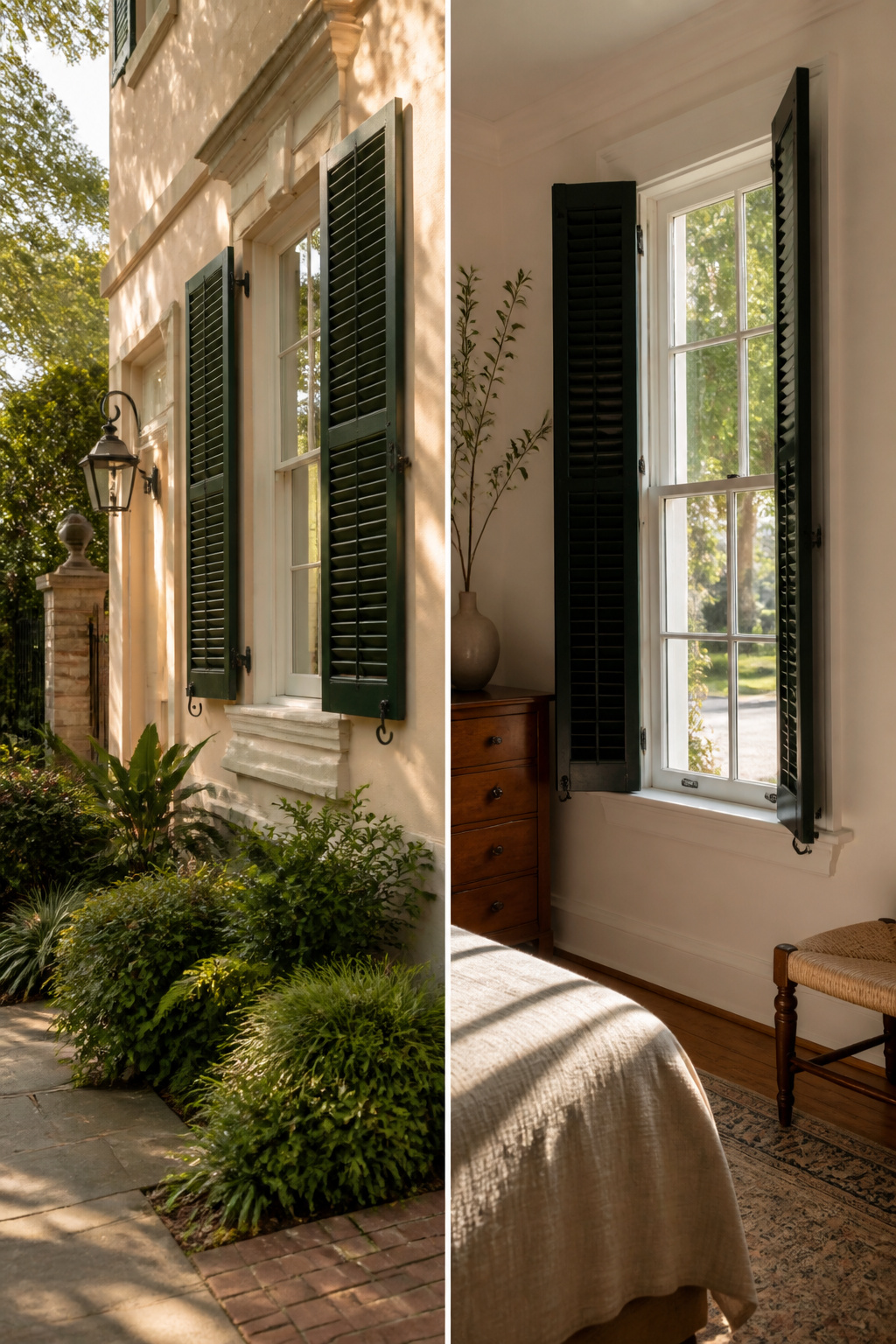
Charleston Green carries an LRV of roughly 4 to 6, which sits it right at the edge of visible light reflection. From across the street, that near-black void reads as pure shadow, and the color only surrenders its green secret once you are close enough for the louvers to catch direct light. The sheen matters more here than with lighter colors; satin to semi-gloss on shutters lets the surface do this work, while flat paint collapses the green entirely into dead black.
That same low LRV is why the color behaves like a heat sink on anything larger than a shutter or door. The surface absorbs nearly all visible light, and in hot climates that energy has to go somewhere. South or west-facing walls in Charleston Green will run noticeably warmer than the same facade in a mid-tone, which accelerates fading and can stress paint film over time. Small surfaces let the color do what it does best: flirt with black from a distance, then reveal depth up close, without the thermal penalty that comes from wrapping a whole house in it.
Testing Before You Paint
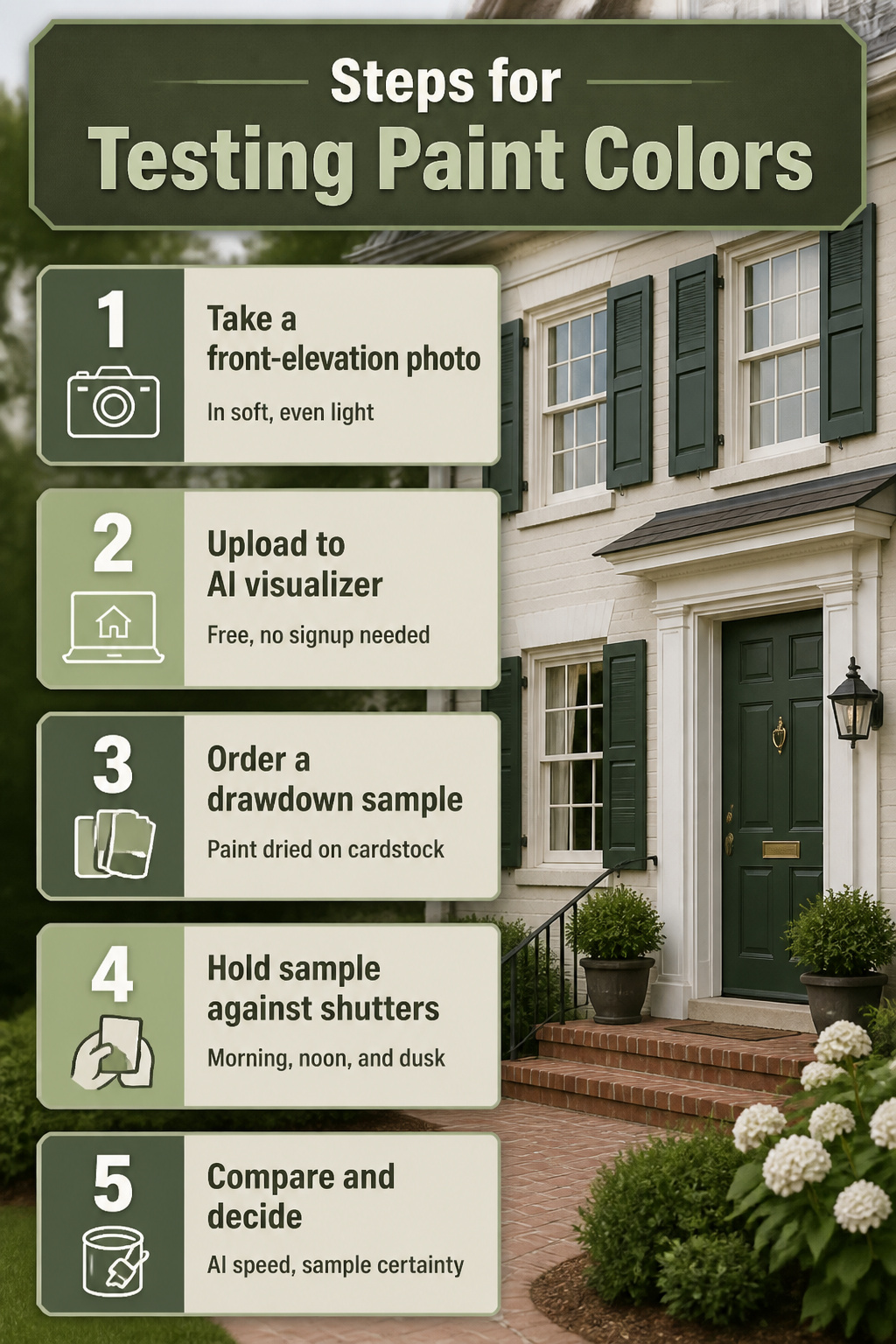
Dark, near-black colors are the hardest to judge from a chip. The swatch always looks blacker and flatter than the finished, light-reflecting surface, so two quick tests remove the guesswork before you buy a gallon.
- Take one front-elevation photo in soft, even light, on an overcast day or in open shade. Harsh direct sun flattens dark greens into pure black on camera and hides the very effect you are testing. Upload to a free AI exterior visualizer, no signup needed for the first render. Enter Charleston Green as hex #23312A, or test its named equivalents Essex Green and Black Forest Green 2047-10 side by side. Apply it to shutters and the door first, then optionally to the body, so you see the accent use before deciding whether to go further. Re-render at a second time of day to confirm the green reads the way you want in both flat and raking light. The whole process takes about fifteen minutes and costs nothing.
- Order a physical drawdown sample, which is simply the paint dried onto cardstock the way it will actually look on a finished surface. Hold it against your shutters at morning, noon, and dusk. This costs a few dollars and a day of drying, but it catches what screens miss: the subtle warmth or coolness Charleston Green picks up from your particular brick, siding, and surrounding plantings.
Between the two, the AI render saves a trip and tells you faster; the drawdown sample settles arguments about sheen and texture that no screen resolves. For a weekend project with a few hundred dollars on the line, running both takes an extra hour and removes the one risk you cannot afford: painting the whole house only to find the color goes flat.
Sheen for Shutters and Doors
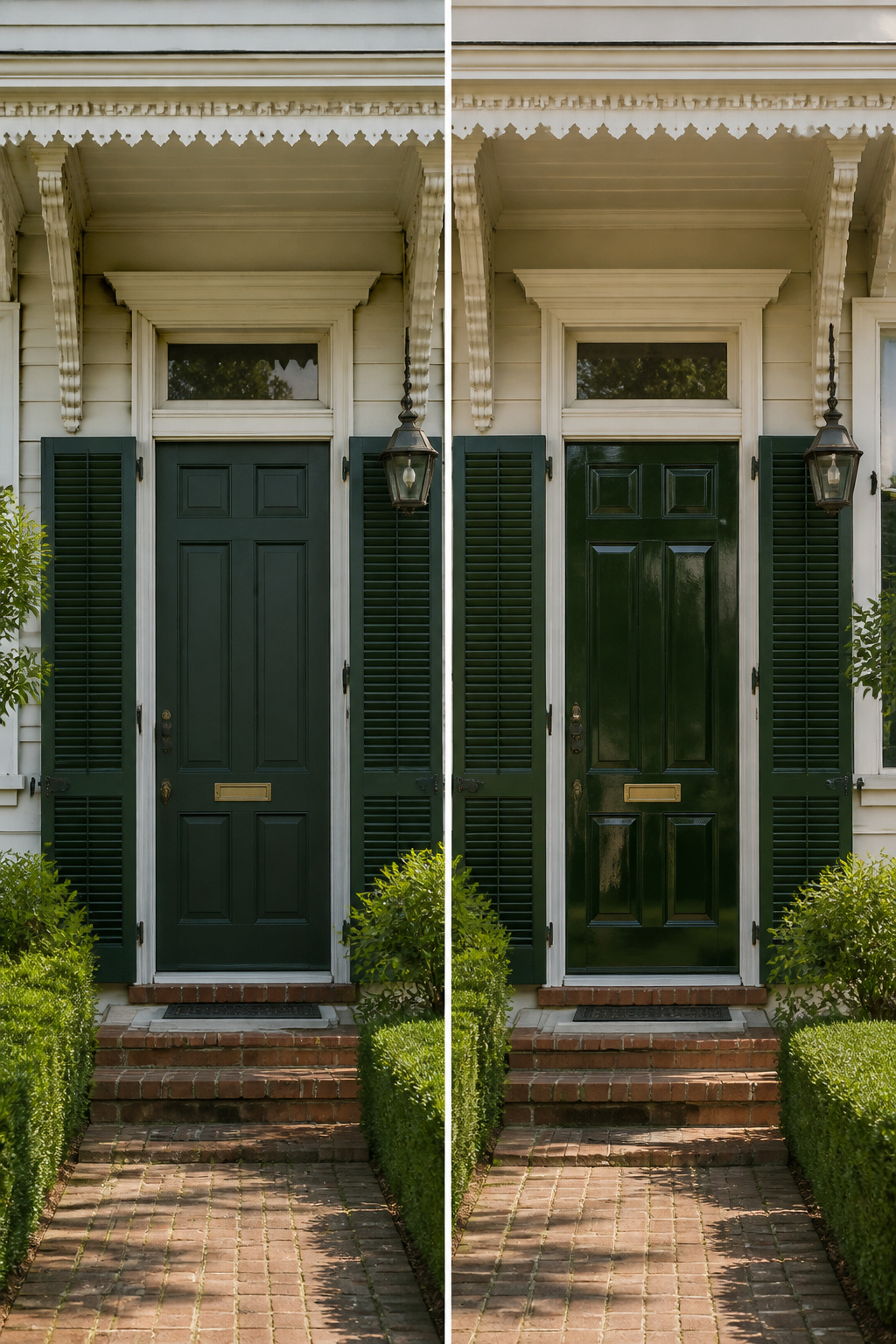
Satin to semi-gloss on shutters catches light across the louvers and lets the green show through, while flat finishes on a dark surface like this read as a dead black void and waste the undertone you chose the color for. The slats need that middle ground, enough gloss to create shadow and depth without looking wet or plastic.
A period front door is different. High-gloss there gives the classic Charleston depth, a deliberate shine that reads as maintained and intentional rather than accidental. The flat planes and smaller surface area of a door handle light differently than shutter louvers do; the gloss becomes a feature, not a distraction.
The distinction matters if you are painting both in the same weekend. Buy the sheen before you buy the color, because the same Charleston Green shifts noticeably between satin and high-gloss under the same midday sun. I have seen the satin read almost olive on a louver while the high-gloss door two feet away held its near-black. Plan for that separation, or you will be repainting one of them the following Saturday.
Why Not the Whole House
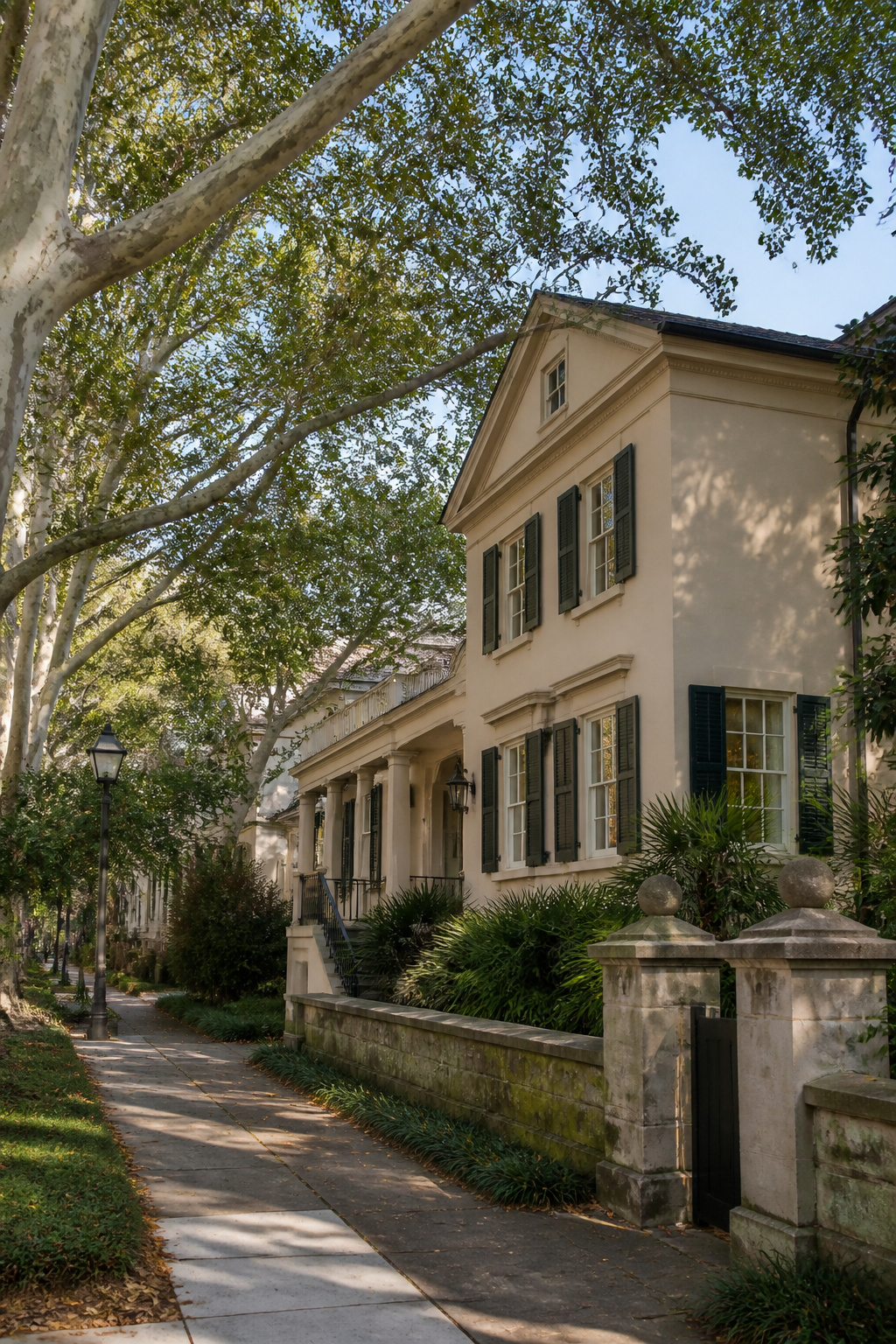
Charleston Green carries an LRV low enough to behave like a near-black on your walls, and that darkness comes with real consequences for large surfaces. South and west elevations absorb significant heat under this color, and the fade shows faster there than it would on shutters or a front door. I learned to read "accent color first" as a technical recommendation, not just tradition.
The safer play keeps Charleston Green where the surface area stays small: shutters, doors, ironwork, the kinds of spots that gain depth from a dark tone without the thermal load. If you are set on using it as a body color, as some modern farmhouses do now, specify a premium exterior line and preview it on your actual facade first. The cost of skipping either step is a repaint you will notice every afternoon when that wall faces the sun.
Picking Between the Six Greens
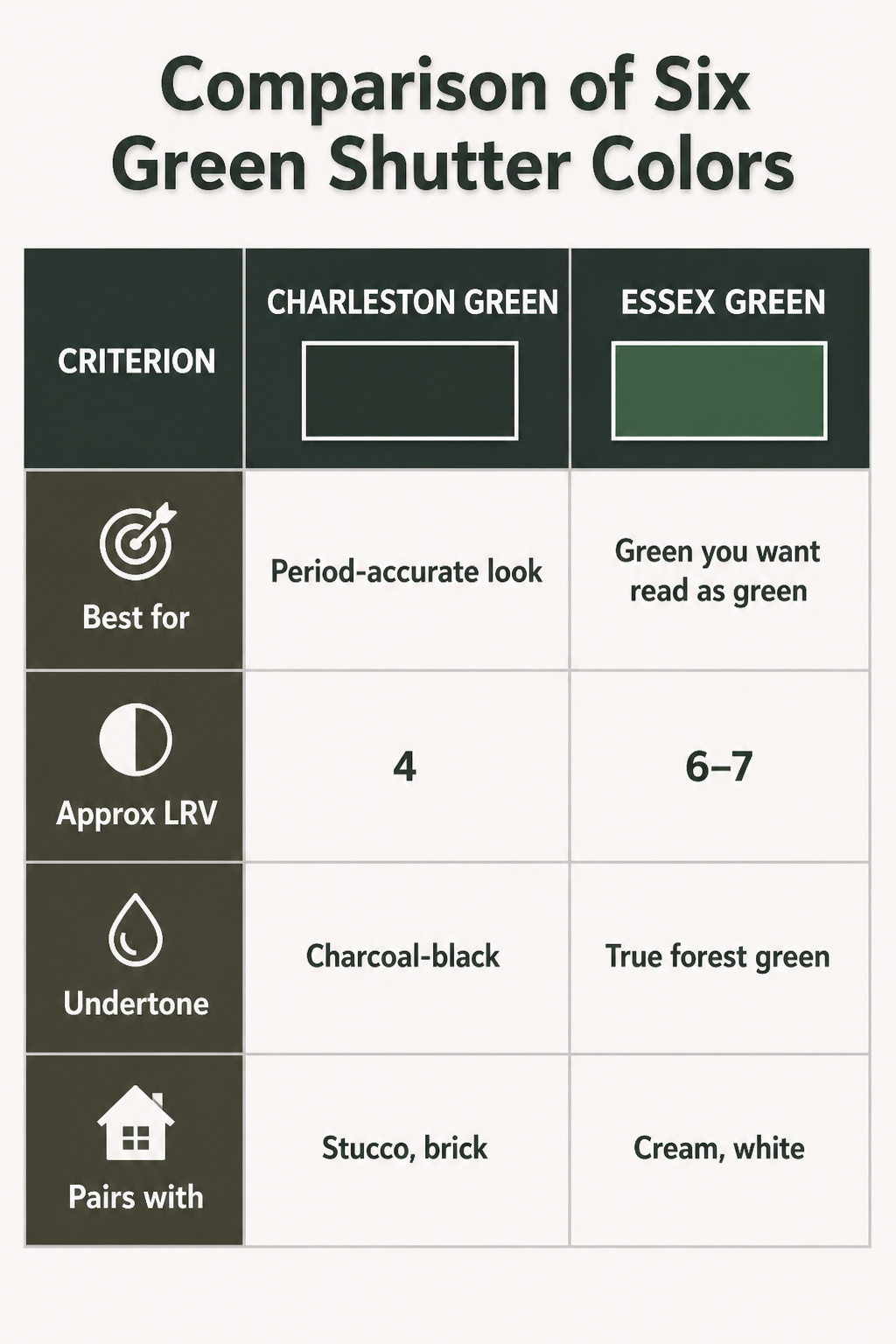
Charleston Green should read black in sun and reveal green in shade and low light, but most people choosing a shutter color are not restoring a historic house. They want the feel without the committee, or they want green that reads as green from the sidewalk. The six options split cleanly into three jobs.
For period accuracy on actual Charleston architecture, stick with the original: a custom match to hex #23312A, LRV around 4. It is the most black of the group, charcoal-warm, and it belongs beside stucco, brick, haint-blue ceilings, and brass hardware. Anything lighter reads as a copy.
If you want the modern trick of a black that secretly green, Black Forest Green 2047-10 sits close, LRV 5–6, with a cooler undertone. It pairs with white trim and warm wood without the place-specific baggage. Essex Green, LRV 6–7, is the choice when you actually want neighbors to notice the color. It reads clearly as dark green at distance, works with cream or natural cedar, and forgives a wider range of existing trim.
| Charleston Green | Black Forest Green | Essex Green | |
|---|---|---|---|
| Best for | Period-accurate Charleston look | Modern "secretly green" black | Green you want read as green |
| Approx LRV | 4 | 5–6 | 6–7 |
| Undertone | Charcoal-black with faint warm | Cool black-green | True forest green |
| Pairs with | Stucco, brick, haint blue, brass | White trim, warm wood, black hardware | Cream, white, natural cedar |
Sun exposure matters more than people expect. South-facing shutters in direct light will bleach any near-black toward brown within a few seasons, so the slight extra pigment in Essex Green or Black Forest Green holds better. North-facing shade keeps Charleston Green’s subtlety alive, but in dim light it can simply look dirty if your trim is already warm. Test with two coats on a primed board, 24 by 36 inches, held beside the actual shutter at three times of day. Flat versus gloss changes these colors dramatically; never judge from a swatch flat on a table.
Frequently Asked Questions
What color is Charleston Green exactly?
Charleston Green is an almost-black green that reads as flat black from across the street, then resolves into deep forest-green up close or in raking light. Its approximate hex is #23312A, with RGB values near 35, 49, 42. The color only surrenders its green secret once you are close enough for the louvers to catch direct light.
What is the LRV of Charleston Green?
Charleston Green carries an LRV of roughly 4 to 6, right at the edge of visible light reflection. That very low value is what lets it absorb enough light to read as near-black from a distance while still holding a green undertone that keeps it from going dead-flat like true black.
What is the closest Benjamin Moore color to Charleston Green?
Benjamin Moore Essex Green is the closest off-the-shelf match in feel, the classic deep shutter green most painters reach for when a homeowner asks for Charleston Green and the local store does not carry a custom match. Black Forest Green 2047-10 sits darker and more black-leaning, reading nearly identical to Charleston Green in low light. For an exact match, any Benjamin Moore store can custom-blend to approximately #23312A in Aura Exterior or Regal Select Exterior.
Can I use Charleston Green on my whole house?
You can, but the near-black LRV absorbs significant heat on south and west elevations, accelerating fading and stressing the paint film over time. The safer play keeps Charleston Green on small surfaces like shutters, doors, and ironwork where it gains depth without the thermal penalty. If you are set on using it as a body color, specify a premium exterior line and preview it on your actual facade first.
What sheen should I use for Charleston Green shutters and doors?
Use satin to semi-gloss on shutters so the louvers catch light and reveal the green undertone; flat finishes on a dark surface read as a dead black void and waste the color you chose. For a period front door, high-gloss gives the classic Charleston depth, a deliberate shine that reads as maintained and intentional. The same Charleston Green shifts noticeably between satin and high-gloss under the same midday sun, so plan that separation before you buy.